Window and Door Weather Stripping Overview for Draft Sealing and Fit
Window and door weather stripping is a movable-edge sealing method used around doors and operable windows to help reduce drafts, air leakage, dust, and moisture where gaps form during normal opening and closing. Its main sealing purpose depends on creating suitable frame contact between the seal profile and the moving edge rather than filling every opening around a building.
Window and door weather stripping is applied where doors and windows meet their frames, including contact points around a door frame, window sash, or other operable edges. Different weather seals, draft seals, and sealing strips are designed for different gap conditions, movement patterns, and materials, so the effectiveness of draft sealing usually depends on fit, gap size, surface condition, and how the seal maintains contact during movement.
Understanding the overall role of weather stripping starts with recognizing the relationship between the seal profile, frame contact, movable edges, and air leakage. These factors influence which type of seal may be appropriate and how it can perform in a given situation. This overview focuses on those decision foundations before moving into detailed discussions about installation, repair, or product selection.
Weather stripping is intended for movable contact areas rather than every gap around a building. Fixed cracks or stationary joints may require a different sealing method, such as caulk, while products such as window film serve a different purpose from sealing strips installed along moving doors and windows.
What Window and Door Weather Stripping Is
Window and door weather stripping is a strip or seal installed around movable doors and operable windows to reduce unwanted air movement through gaps. It creates contact between the moving edge and the frame instead of filling every opening around a building. Its primary function is to help reduce drafts by limiting air movement where the door or window closes.
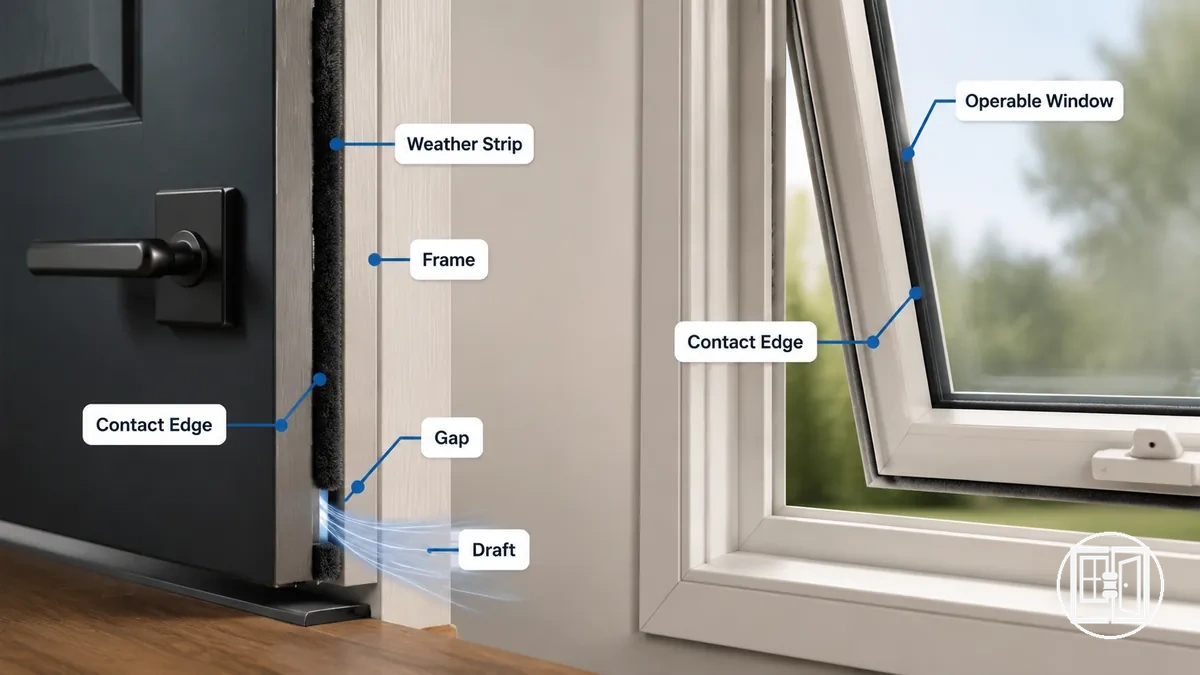
Weather stripping is typically placed along contact points on a door frame, window sash, or other operable window and door components where repeated opening and closing create movable gaps. It is commonly available in different strip and seal forms made from different materials, but each is intended to create contact between the movable edge and the frame. Weather stripping is designed for movable doors and operable windows rather than every gap around a structure.
For example, a draft coming through the contact edge of a door or window may be addressed with weather stripping, while a fixed crack beside trim or another stationary joint may require a different draught-proofing method. Weather stripping is not a permanent structural repair or a universal gap filler.
How Weather Stripping Works Around Movable Doors and Windows
Weather stripping works by creating contact between a moving door or window and its frame to help reduce unwanted air movement through gaps. As movable doors and operable windows close, the seal profile compresses, brushes against, or covers the contact area to help reduce drafts, dust, moisture, and, in many cases, noise. The sealing action depends on consistent frame contact.
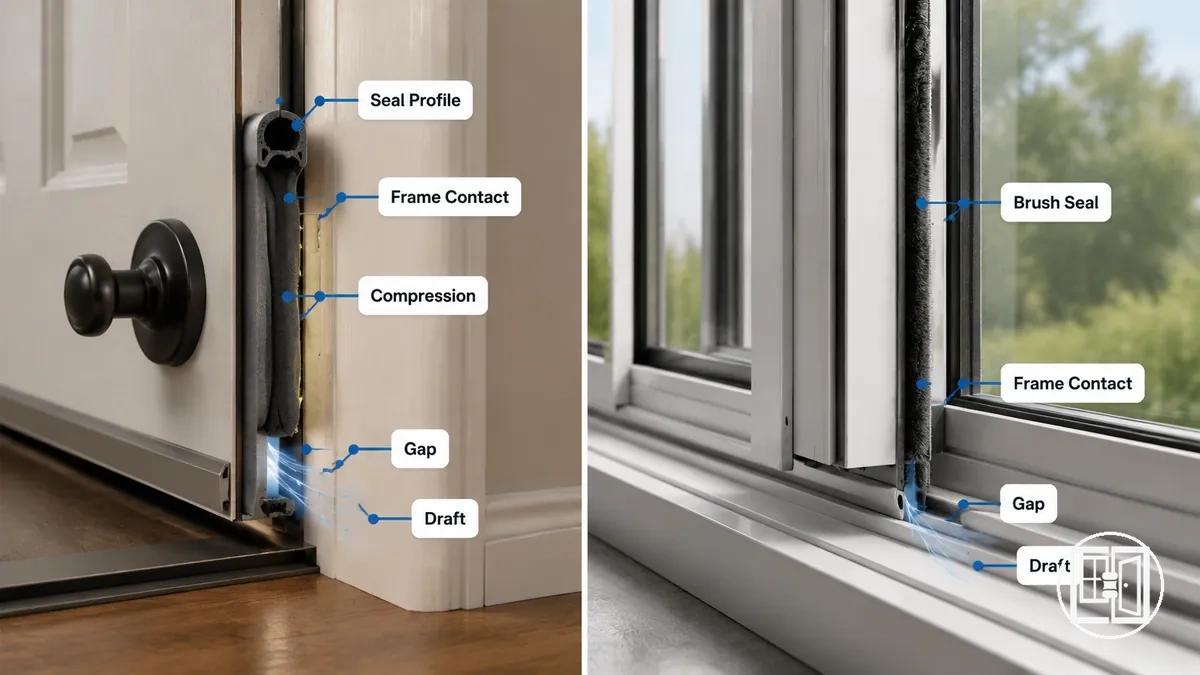
Different seal profiles work in different ways. A compression seal presses against the frame when the door or window closes, while a brush seal lightly contacts a sliding track to help limit drafts without preventing normal movement. Other sealing edges cover small gaps as the movable part reaches its closed position. How well each approach performs depends on the gap condition, contact pressure, and how closely the seal profile matches the frame.
Weather stripping can perform differently on hinged doors, sliding windows, sash windows, and uneven frames because each design creates a different movement path and contact pattern. The same strip may provide different results when gap size, friction, or closure movement changes. Understanding these relationships helps explain how weather stripping works without turning the discussion into installation guidance.
What Weather Stripping Can and Cannot Seal
Weather stripping is suitable only for gaps where a door or window moves against its frame. Whether it can help depends on the gap location, the contact path, and whether the opening is movable or fixed. Movement and location determine the appropriate sealing method.
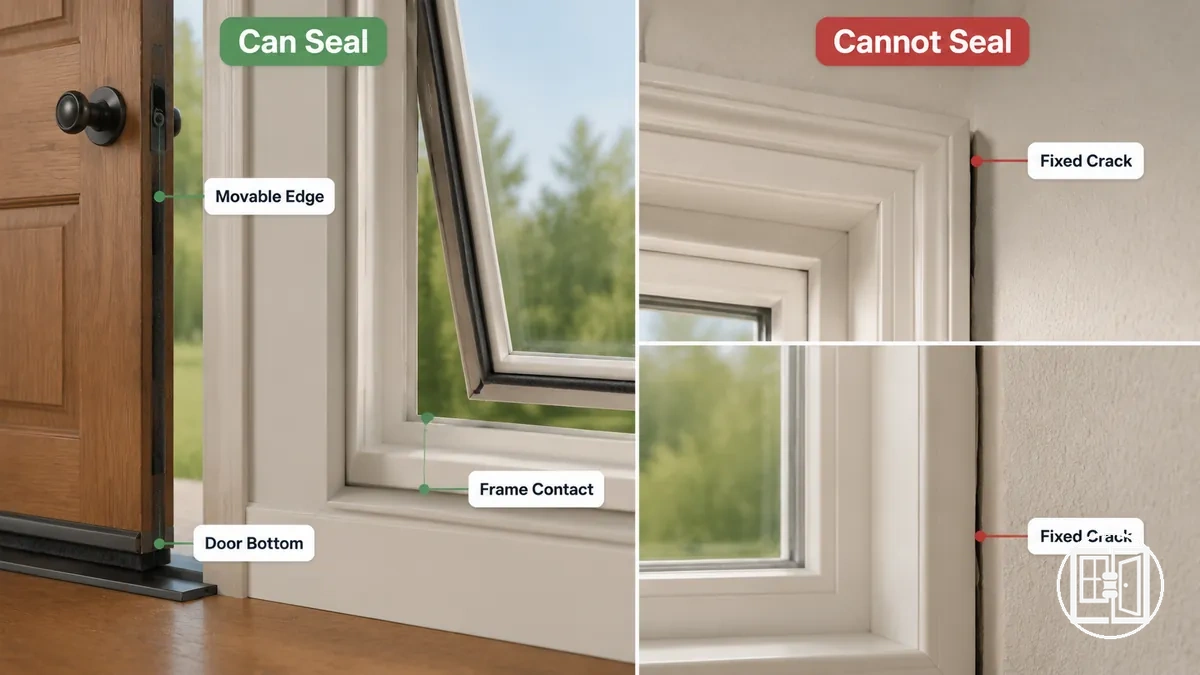
| Gap or location | Weather stripping fit | Better method or limitation |
|---|---|---|
| Movable contact edges | Suitable when the seal maintains frame contact during movement | Depends on fit, gap size, and surface condition |
| Door bottoms | Can help reduce drafts when the sealing strip maintains contact | Performance depends on floor clearance and contact |
| Window sash gaps | Can help where the sash closes against the frame | Limited to the movable edge and contact path |
| Fixed trim gaps | Not intended for fixed gaps | Caulk is often a more suitable sealing method |
| Wall-to-frame gaps | Outside the normal contact path | May require a different sealing method rather than weather stripping |
Weather stripping is designed for movable edges where repeated opening and closing create a sealing contact. It can help reduce drafts around doors, operable windows, and other contact edges when the seal matches the gap condition and maintains frame contact. Its function is limited to movable contact areas rather than fixed cracks or stationary openings.
Weather stripping is not a replacement for caulk, window film, foam, or structural repair because those products address different conditions. Fixed cracks, trim gaps, wall-to-frame gaps, and damaged structural joints usually require a different approach since they do not rely on a moving contact surface. If a draft is felt near a window frame, it may come from the sash contact area or the surrounding trim, so identifying the draft source helps determine the appropriate sealing method.
Movable Edges Versus Fixed Cracks and Gaps
A movable edge depends on movement during opening and closing, while a fixed crack remains in the same position. This distinction helps classify a gap before choosing a sealing method. The simplest check is the movement test.
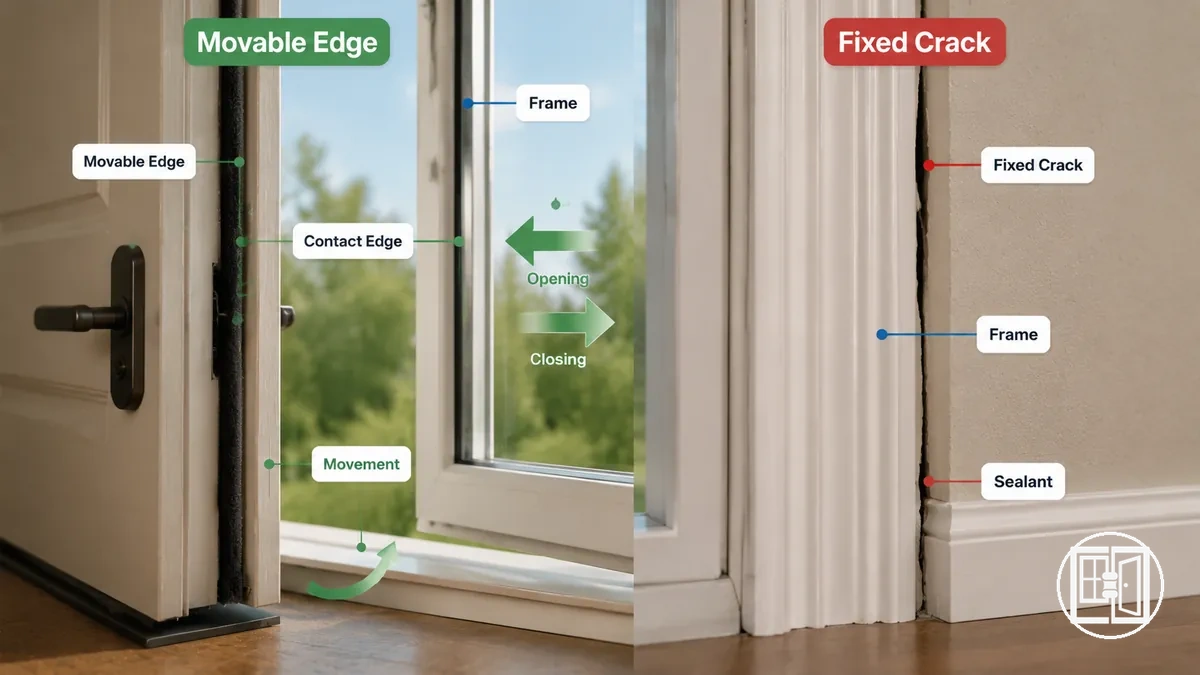
The checklist below classifies the gap by movement and location before choosing a sealing route.
- If the gap changes as the door or window opens and closes at the contact edge, weather stripping may be the appropriate sealing route.
- If the gap stays in the same place on the frame or trim, it is more likely a fixed crack that may require a sealant.
- If the contact point moves with the sash or door, classify it as a movable edge before selecting weather stripping.
- If the gap remains unchanged regardless of movement, treat it as a fixed gap and consider a different sealing route.
Gap behavior helps confirm the classification without identifying the exact cause of a draft. For example, air entering through a moving door contact edge may indicate weather stripping is suitable, while a stationary trim gap may be better suited to a filler or sealant. The appropriate sealing method depends on the observed movement and gap location rather than a guaranteed diagnosis.
Weather Stripping Versus Caulk, Window Film, and Draft Blockers
Weather stripping, caulk, window film, and draft blockers are designed for different sealing locations and are not interchangeable. Weather stripping is intended for moving edges, caulk for fixed cracks, window film for the window surface, and draft blockers for temporary coverage at a door bottom. Each option fits a different gap or surface type.
The comparison below separates these adjacent sealing paths by location and function. It keeps weather stripping as the contact seal for movable gaps while showing where other methods may suit different conditions. The comparison is limited to defining these boundaries rather than serving as a complete draught-proofing guide.
| Option | Best-matched location | Main limitation |
|---|---|---|
| Weather stripping | Moving edges where a door or window closes against a frame | Suitability depends on contact, fit, and gap location |
| Caulk | Fixed cracks around trim or other stationary joints | Not intended for moving edges |
| Window film | Window surface where an insulation film is appropriate | Does not replace a contact seal around moving edges |
| Draft blockers | Door bottom where temporary blockage may be suitable | May not address gaps around the rest of the door or window |
Weather stripping remains the anchor solution when the gap occurs along a moving contact edge. Caulk, window film, and draft blockers address different locations and functions, so suitability depends on the gap type, surface condition, and intended use rather than treating one option as a universal substitute.
Main Weather Stripping Types and Seal Profiles
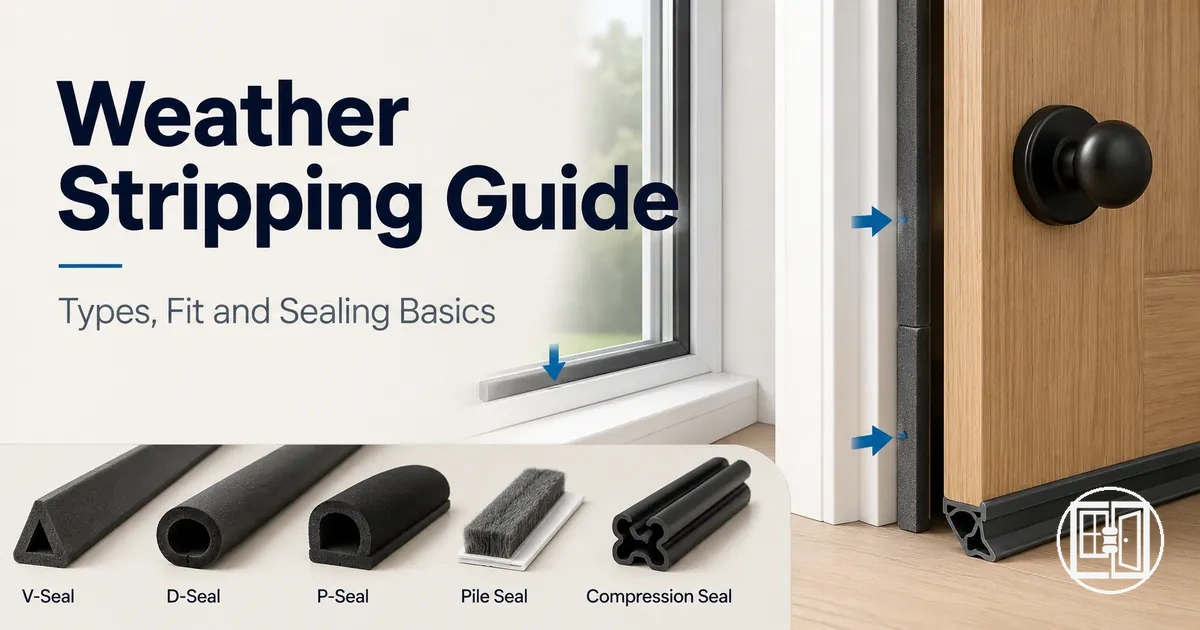
Weather stripping types are grouped into seal profiles that differ by material, shape, contact behavior, and intended position. Common seal profiles include foam, adhesive tape, rubber, compression, V-seal, door sweep, and pile brush designs. These profile differences matter because they influence draft control, movement, durability, and gap tolerance.
The table below organizes the main weather stripping types by profile, contact behavior, typical position, and fit considerations. While many seal profiles appear similar, each is intended for different movement patterns and frame conditions rather than the same application.
| Profile type | Contact behavior | Typical position | Fit caution |
|---|---|---|---|
| Foam | Compresses against the frame | Doors and windows with light gap variation | Gap tolerance depends on compression and surface condition |
| Adhesive tape | Creates surface contact through an adhesive-backed strip | Frames where adhesive installation is suitable | Performance depends on adhesion and fit |
| Rubber / Compression | Forms a contact seal when compressed | Door and window frames with repeated closing movement | Requires consistent frame contact |
| V-seal | Flexible folded profile closes against the gap | Door or window edges | Works best when the profile matches the gap shape |
| Door sweep | Seals along the bottom edge during closing | Door bottom | Depends on floor clearance and contact |
| Pile brush | Brush fibers maintain contact with moving surfaces | Sliding tracks and sliding frames | Movement, friction, and wear may affect suitability |
Material, profile shape, contact behavior, and installation position work together when comparing weather stripping types. Foam, adhesive tape, rubber, compression, V-seal, door sweep, and pile brush profiles each suit different movement patterns and gap tolerance, so fit depends on the opening and frame conditions rather than the profile alone.
Key decision signals include frame contact, movement during opening and closing, expected durability, and the amount of gap tolerance required. For a more detailed breakdown of each seal family, see weather stripping types explained.
Foam, Adhesive, Rubber, Compression, and V-Seal Profiles
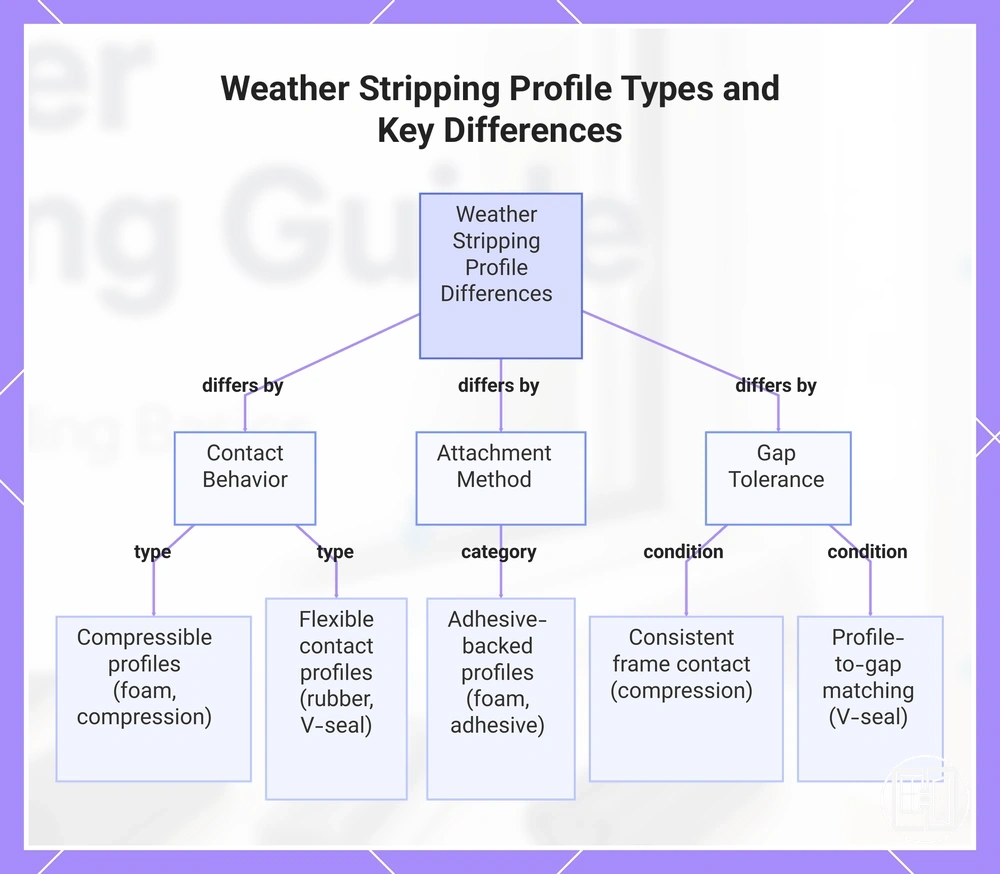
Foam, adhesive, rubber, compression, and V-seal profiles are common weather stripping families that differ in contact behavior, compressibility, attachment, and gap tolerance. Each profile is intended for different frame conditions and movement patterns rather than serving the same purpose. Profile performance depends on fit, frame cleanliness, exposure, friction, and movement frequency.
The points below highlight the main profile differences without replacing the broader type overview.
- Foam: Foam profiles compress to help seal small gaps and are commonly supplied as an adhesive-backed strip. Compressibility can accommodate minor gap variation, while wear may depend on repeated movement and surface condition.
- Adhesive: Adhesive or self-adhesive strip profiles rely on surface attachment rather than mechanical fixing. Attachment depends on a clean surface, and wear may increase if the bond is affected by exposure or frequent use.
- Rubber: Rubber seal profiles provide flexible contact behavior where repeated opening and closing occurs. Durability and wear can vary with friction, movement, and operating conditions.
- Compression: Compression profiles form a seal by pressing against the frame as the opening closes. Gap tolerance depends on consistent frame contact rather than compression alone.
- V-seal: V-seal or V-strip profiles use a folded shape that flexes along the contact edge during movement. Suitability depends on matching the profile to the gap while limiting wear caused by repeated friction.
This chart compares five common weather stripping families (foam, adhesive, rubber, compression, V-seal) based on their contact behavior, attachment method, and gap tolerance.
Door Bottom, Frame, and Window Sash Seal Positions
Seal position depends on where a door or window moves against the frame because the same weather stripping profile may perform differently by location. Common seal positions include the door bottom, jambs, stops, window sash edges, meeting rails, sliding tracks, and other frame contact points. Position influences how the seal follows movement and maintains contact during opening and closing.
The checklist below organizes common seal positions by part and movement. A door-bottom draft and a side-jamb draft may require different seal placement because the contact path changes with location. The most suitable seal position depends on movement, contact points, and how closely the profile matches the frame.
- Door bottom: Moves across the threshold during closing and may use a sweep-style seal. Suitability depends on floor clearance and the contact path.
- Jambs: Provide side frame contact as the door closes. Seal position depends on consistent contact along the frame edge.
- Stops: Form the closing surface where the door meets the frame. Seal behavior depends on alignment and repeated contact.
- Window sash edges and meeting rails: Move as the sash opens and closes. Seal position should match the movement and contact location between the sash and frame.
- Sliding tracks: Guide moving panels where pile brush profiles are commonly used. Friction and repeated movement may influence wear and sealing performance.
- Other frame contact points: Contact locations vary by door and window design. The most suitable seal position depends on where air leakage occurs during normal movement.
Fit Factors: Gap Size, Frame Contact, and Movement
Fit factors determine whether a weather stripping seal can perform as intended. Gap size, frame contact, movement, closing pressure, and compression depth influence how the seal responds when a door or window closes. Together, these fit factors are the primary condition that affects sealing performance.
Gap size should be assessed together with gap consistency rather than gap width alone. A seal that matches one section of the frame may respond differently where the gap changes, reducing consistent frame contact. Surface cleanliness may influence adhesive contact, while frame material can affect how closely the seal follows the contact surface. If these fit conditions vary across the opening, sealing performance may also vary.
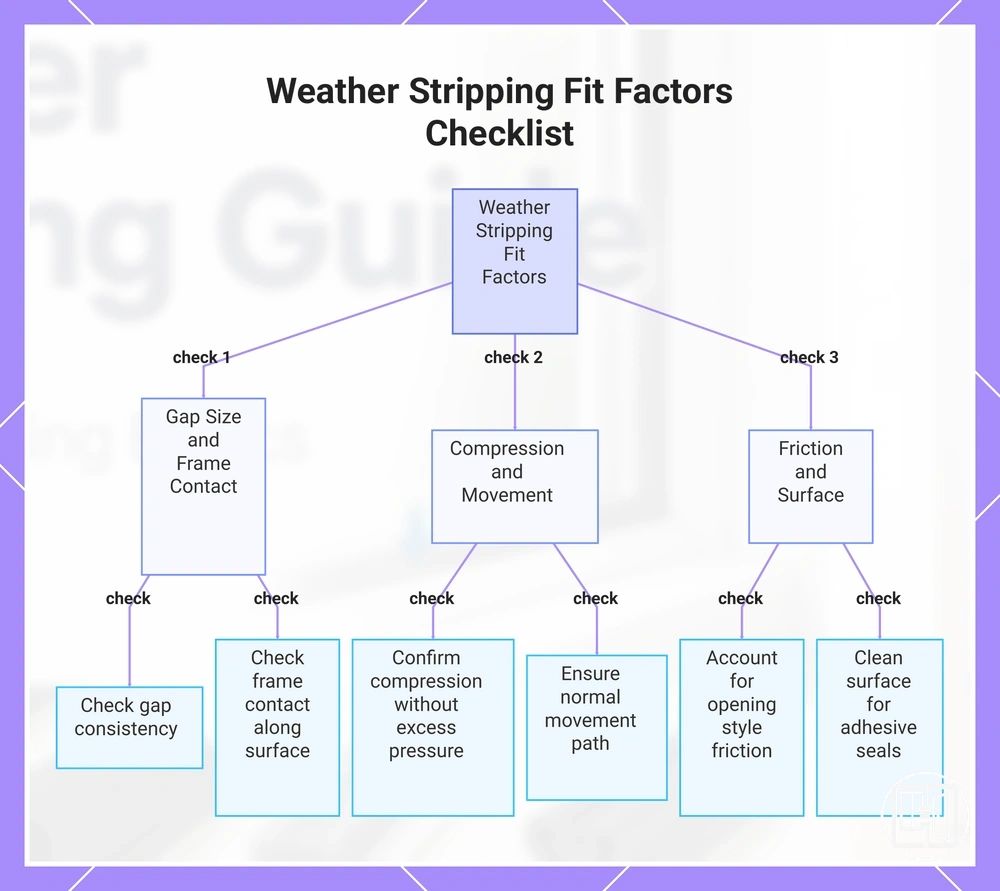
The mini-checklist below helps verify fit factors before seal choice.
- Gap size: Observe whether the gap remains consistent. Large changes in gap width may require a different seal response.
- Frame contact: Check whether the seal can maintain contact along the closing surface instead of touching only isolated points.
- Closing pressure and compression depth: Confirm that the seal can compress during closing without depending on excessive contact pressure.
- Clearance and movement: Ensure the opening can follow its normal movement path without unnecessary interference.
- Friction and opening style: Hinged and sliding openings create different movement paths, so friction and wear may differ by design.
- Surface cleanliness: For adhesive-backed seals, a clean contact surface may reduce the risk of poor adhesion.
Movement path and friction influence how a seal responds over repeated opening and closing. Sliding openings may create different contact behavior from hinged doors because the movement path changes where the seal meets the frame. These decision signals can help when comparing seal types, choosing an appropriate strip, or inspecting a possible mismatch. For broader selection criteria, see how to choose the right seal.
This chart groups the six key fit factor checks into three categories to help verify weather stripping seal performance.
Common Draft Points Around Doors and Windows
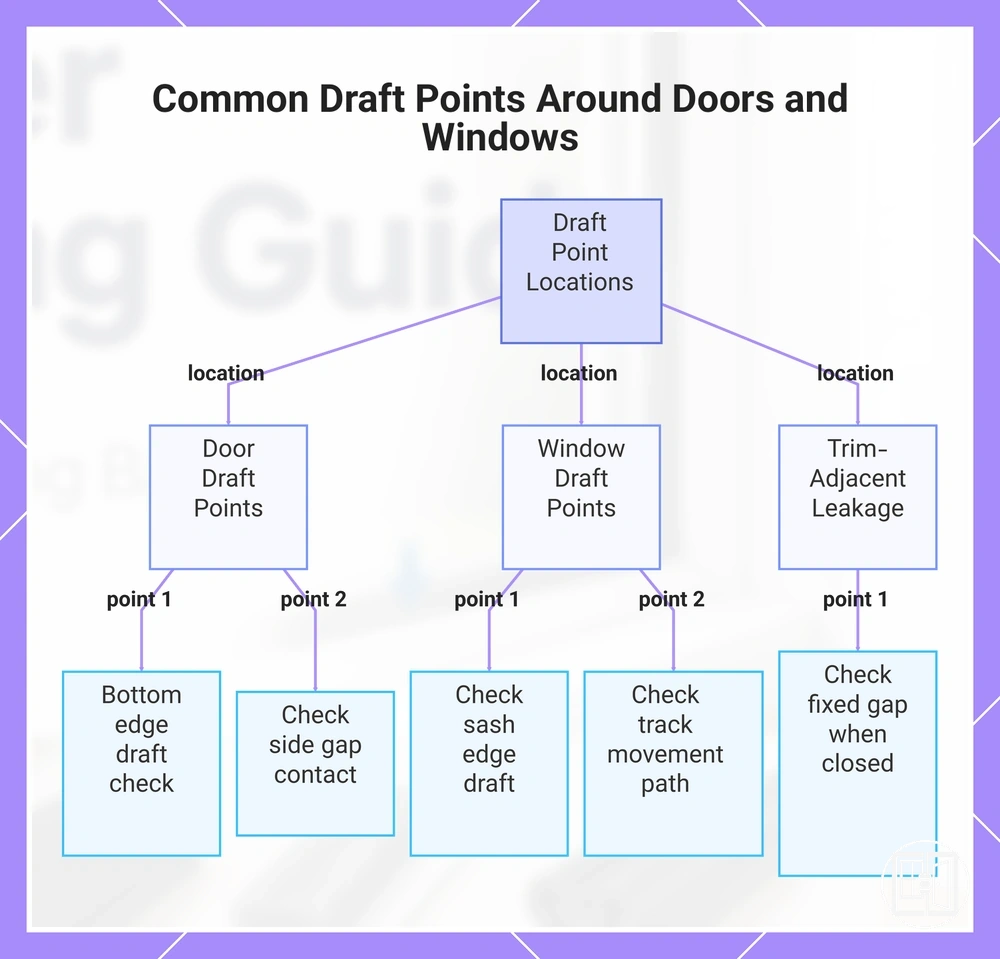
When drafts are noticeable around doors or windows, the air leak often comes from a specific contact point rather than the entire opening. Weather stripping may help in some cases, but draft points can also result from worn seals, misalignment, or nearby fixed gaps. Identifying the likely gap location is the first step because drafts may originate from different parts of the opening.
Door draft points commonly occur at the door bottom, hinge-side gap, latch-side gap, or other frame contact areas. A worn sweep near the threshold or reduced frame contact along the door edge may allow air leaks during normal use. Misalignment can also change how the door meets the frame even when weather stripping is present. Matching the symptom to the likely location helps guide the next check.
The diagnostic checklist below helps locate common draft points around doors and windows before deciding whether weather stripping is the likely cause.
- Door bottom: A draft near the threshold may indicate reduced contact from the sweep. Check whether the air leak follows the bottom edge.
- Hinge-side gap: Air leakage along the hinge side may suggest uneven frame contact. Check whether the gap changes as the door closes.
- Latch-side gap: A draft near the latch side may indicate reduced contact or misalignment. Check whether the seal meets the frame consistently.
- Window sash: Drafts around the window sash edge may point to worn seals or changing contact during opening and closing. Check where the air leak is most noticeable.
- Sliding tracks: Air leaks along sliding tracks may relate to pile brush wear or reduced contact. Check whether the leakage follows the movement path.
- Trim-adjacent leakage: Drafts beside interior trim may come from a fixed gap rather than weather stripping. Check whether the air leak remains when the opening is fully closed.
Window draft points are not always caused by weather stripping. Fixed gaps may require caulk, while misalignment, worn components, or other conditions may require adjustment, replacement, or professional repair instead of another seal. For a broader diagnostic approach, see fixing air leaks and drafts.
This chart shows the most common draft point locations around doors and windows and the key checks to identify each one.
Basic Methods for Sealing Door and Window Gaps
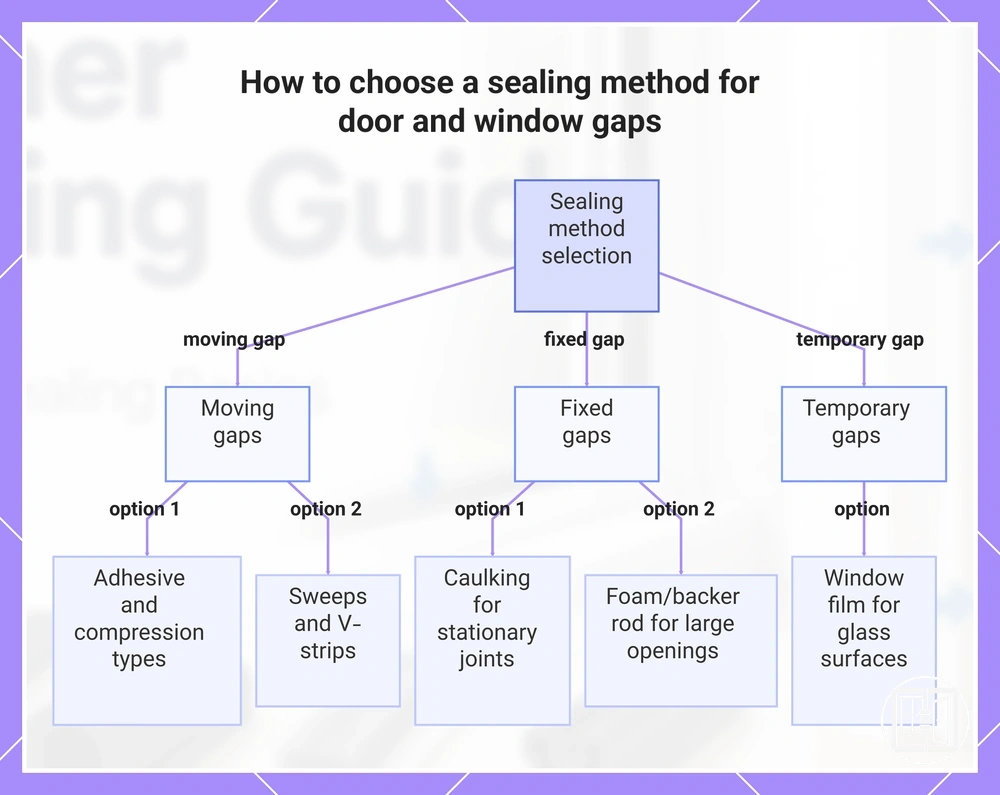
Basic sealing methods for door gaps and window gaps depend on whether the gap is moving, fixed, temporary, or caused by worn material. Weather stripping is generally intended for moving contact edges, while other sealing methods may be more appropriate for fixed gaps or temporary insulation. The appropriate method depends on the gap type.
Weather stripping methods are commonly used where a door or window closes against its frame. Adhesive strips, compression seals, door sweeps, and V-strips each suit different movement patterns and contact conditions rather than every opening. Surface condition, frame contact, and closing pressure may influence how well a seal matches the application. Selecting a method begins with identifying the type of moving gap.
The grouped methods below organize common sealing methods by gap type and reversibility to provide a practical overview rather than an installation sequence.
- Adhesive strips: May suit moving gaps where a clean surface supports reliable attachment. Surface condition should be considered before use.
- Compression seals: Commonly used for moving gaps that rely on consistent frame contact. Suitability depends on fit and closing pressure.
- Door sweeps and V-strips: Door sweeps are generally used at the door bottom, while V-strips may suit certain door or window edges. Movement path and contact should guide selection.
- Caulk: Typically intended for fixed gaps around trim or stationary joints. It is not generally used on moving contact edges.
- Foam or backer rod: May be appropriate for larger fixed openings where the gap condition supports their use. Reversibility and surface condition should be considered.
- Window film: May provide temporary support on the glass surface in appropriate situations. It does not replace weather stripping around moving gaps.
These sealing methods serve different purposes rather than acting as interchangeable solutions. Matching the method to the gap type, surface condition, and desired reversibility provides a more appropriate basis for selection than relying on a single approach.
This chart shows how to select the appropriate sealing method based on gap type (moving, fixed, or temporary) and provides key considerations for each method.
When Weather Stripping Needs Selection, Installation, or Repair Guidance
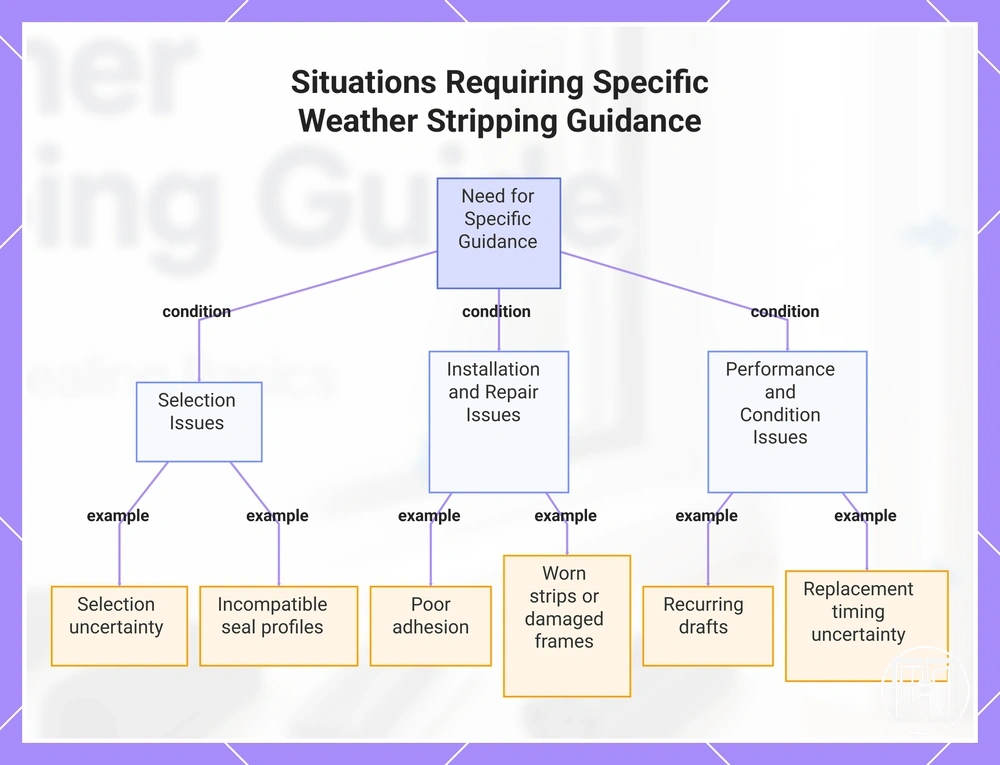
General weather stripping guidance becomes insufficient when the decision depends on a specific fit, installation, or repair condition. Selection guidance, installation guidance, or repair guidance may be needed when seal choice, adhesion, frame condition, or recurring performance issues require a more focused assessment. More specific guidance is appropriate once the issue moves beyond a general overview.
Selection uncertainty often arises when multiple seal profiles appear suitable or when incompatible seal profiles do not match the opening. Poor adhesion may indicate that surface condition needs closer evaluation, while recurring drafts can suggest that the cause extends beyond selecting another seal. Worn strips, misaligned doors, damaged frames, or uncertain replacement timing may also require a more focused troubleshooting path instead of relying on overview-level guidance.
The checklist below identifies common situations where more specific guidance may be appropriate while keeping this section focused on decision readiness rather than detailed procedures.
- Selection uncertainty: Use selection guidance when more than one seal profile appears suitable for the opening.
- Incompatible seal profiles: Seek fitting guidance when the selected profile does not match the gap or movement pattern.
- Poor adhesion: Consider installation or repair guidance when surface condition may be affecting seal attachment.
- Recurring drafts: Follow a troubleshooting path when air leaks continue after the seal appears to fit.
- Worn strips: Review replacement guidance when the existing seal no longer maintains consistent frame contact.
- Misaligned doors or damaged frames: Repair guidance may be appropriate when frame condition affects sealing performance.
- Replacement timing: Look for more detailed guidance when inspection suggests the existing weather stripping may no longer perform as intended.
This chart shows common situations that indicate when general weather stripping guidance is insufficient and more specific selection, installation, or repair guidance is needed.