
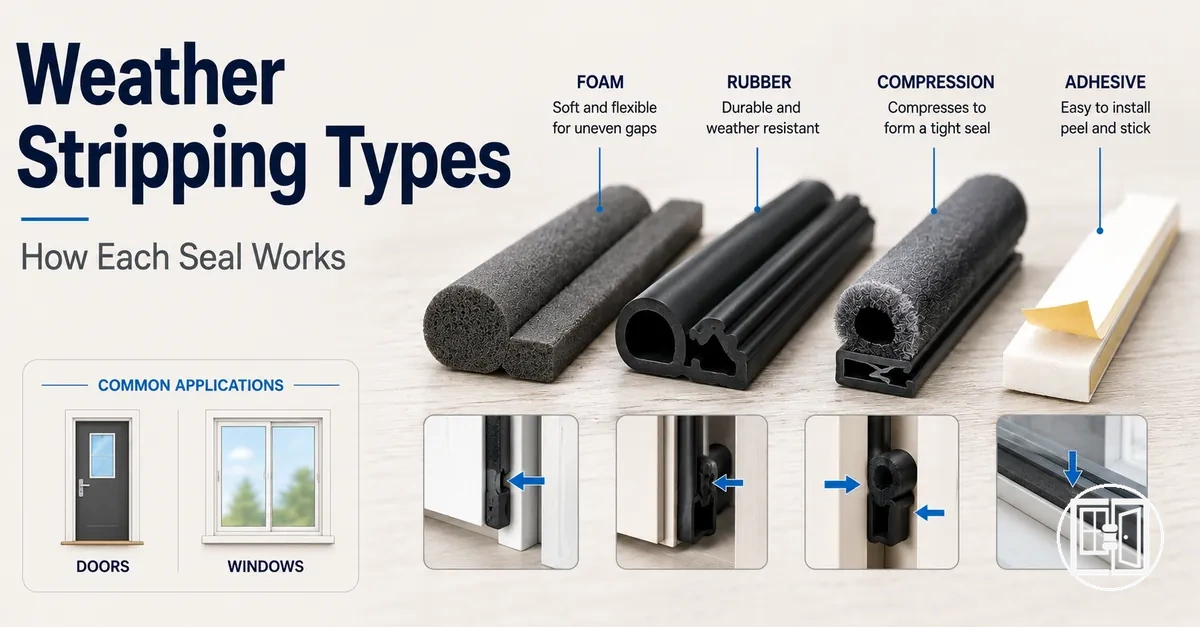
Window and Door Weather Stripping Types and Seal Profiles
Window and door weather stripping is a sealing strip used around a door frame or window frame to reduce a gap where air can pass. This page explains weather stripping by seal type, seal profile, contact method, and fit condition rather than by product choice.
A seal type changes the result because each profile contacts the frame in a different way. Foam tape may rely on soft compression and adhesive backing, while a V-strip may rely on spring tension and a magnetic seal may rely on magnetic contact. Draft reduction can vary when the gap size, frame condition, surface contact, or sash movement does not match the profile form.
The safe way to read weather stripping types is to connect the strip shape to the place it must seal. A door frame often needs enough closing pressure for compression, while a window frame may need a seal position that still allows sash movement. Adhesive backing also depends on surface condition and exposure, so type, material, and final selection should stay separate before the definition section begins.
Weather stripping types differ by profile form and by how the strip contacts the frame. The table below gives a compact orientation before the article moves into the detailed type explanations.
| Seal type | Profile/contact method | Typical location | Main fit condition |
|---|---|---|---|
| Foam tape or sponge strip | Soft compression with adhesive backing | Light gaps around a door frame or window frame | Needs even surface contact and suitable compression thickness |
| Rubber, silicone, or EPDM seal | Flexible compression profile | Moving doors or windows with closing pressure | Needs enough rebound without creating closing resistance |
| V-strip or tension seal | Folded profile that presses across a moving gap | Sash channels, jambs, and narrow moving joints | Needs alignment and a gap shape the profile can bridge |
| Magnetic seal | Magnetic contact against a receiving surface | Compatible door edges or receiving strips | Needs aligned magnetic contact and a suitable closing surface |
What Weather Stripping Types Mean for Doors and Windows
Weather stripping types is a term that refers to different seal forms used to reduce frame gaps around doors and windows. These types describe how a seal profile is shaped and how it functions against a door frame or window frame gap. The main distinction is between seal type and seal profile, where type defines the form and profile defines the contact shape.
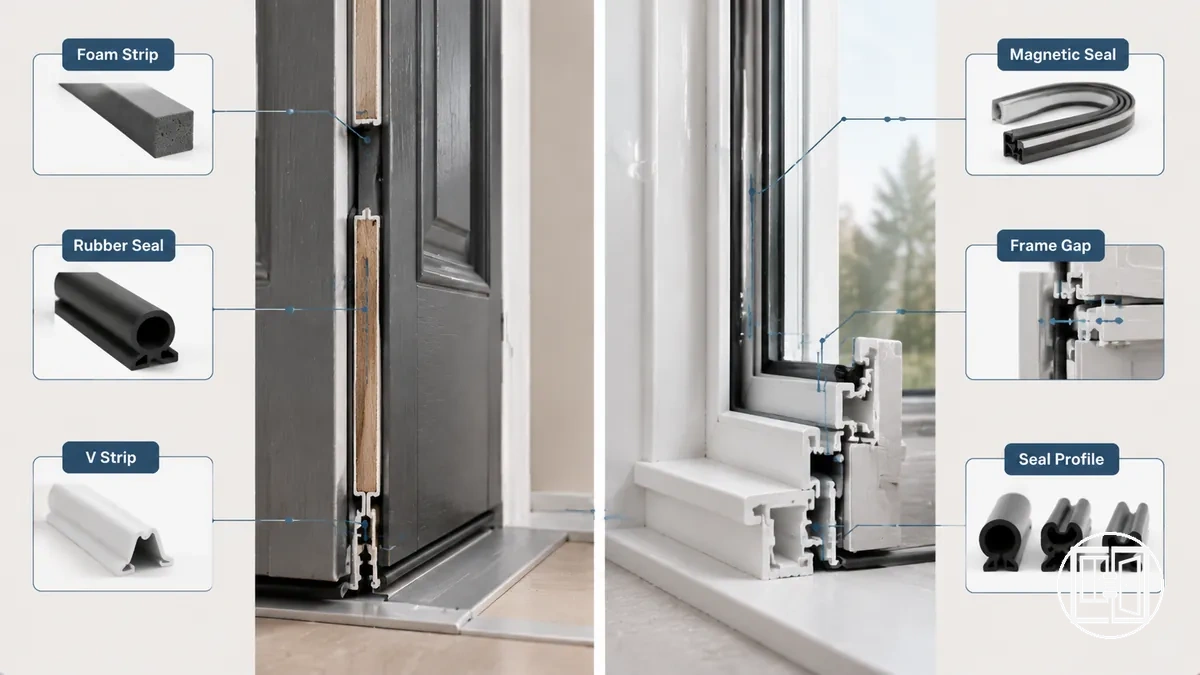
Seal type, material, attachment method, and contact behavior can overlap, but they do not describe the same function. A material such as foam or rubber affects compression, while an adhesive backing changes how the strip bonds to the surface. Contact behavior depends on how the profile meets the frame gap, which can vary across door and window conditions.
Type selection is related to material choice and attachment method, but it is not identical to final selection decisions because each frame responds differently to pressure and movement. This boundary is also clarified in the broader weather stripping overview, where the relationship between seal forms and application context is introduced without merging them into a single concept.
Main Weather Stripping Types Used Around Doors and Windows
Main weather stripping types are grouped by their physical form and how they make contact with doors and windows. These weather stripping types define how seal profiles manage a frame gap through compression, tension, or surface contact. Each group reflects a different interaction between material, shape, and movement rather than a single uniform sealing method.
The same weather stripping type can appear in different profiles depending on where it is used around doors and windows, especially at edges, sashes, or frame gaps with movement. This makes the comparison easier when types are viewed by form and contact behavior rather than individual examples.
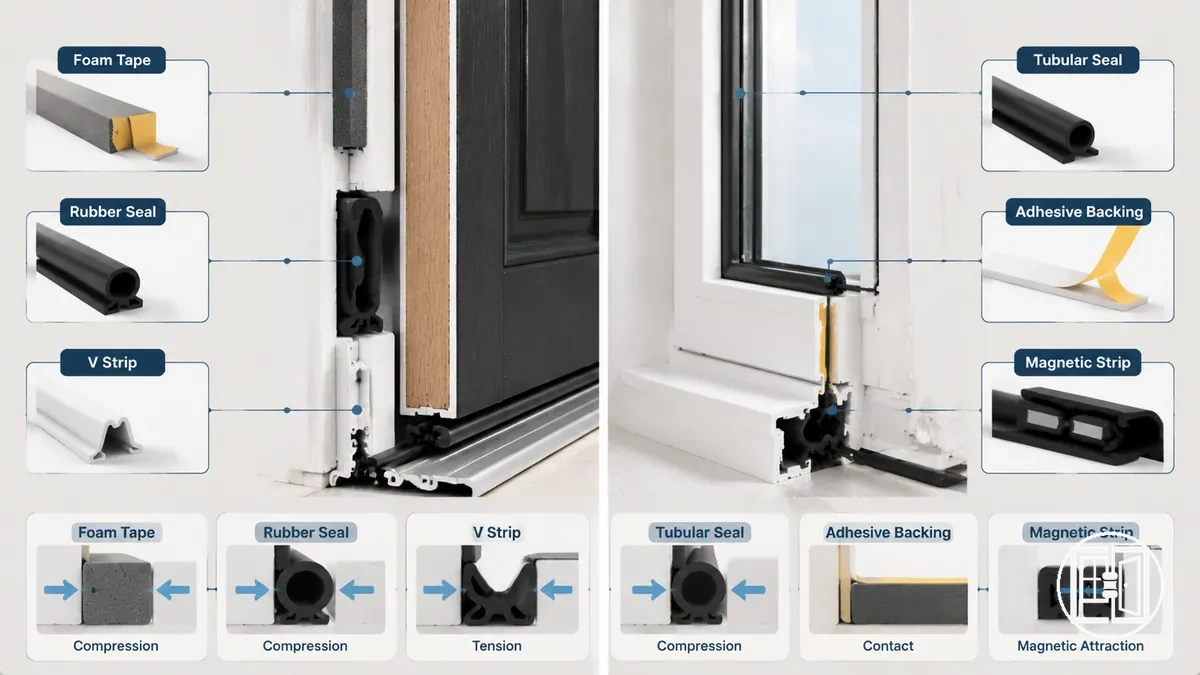
| Type family | Profile or form | Common location | Movement tolerance | Main limitation |
|---|---|---|---|---|
| Foam tape / sponge strip | Soft compressible strip with adhesive-backed tape | Light frame gap areas on doors and windows | Low to moderate compression movement | Can deform under repeated pressure |
| Rubber / silicone / EPDM seal | Elastic compression seal profile | Door frames and window contact edges | Moderate to high compression cycles | Needs consistent closing pressure |
| V-strip / tension seal | Flexible folded strip (tension-based profile) | Sash channels and moving window edges | High sliding movement tolerance | Requires precise alignment |
| Tubular / bulb seal | Hollow or bulb-shaped compression profile | Door edges and frame grooves | Moderate compression with rebound | May not fit shallow grooves |
| Adhesive-backed tape | Flat strip with pressure-sensitive backing | Flat frame surfaces | Low movement tolerance | Weak adhesion on uneven surfaces |
| Magnetic strip | Magnetically aligned sealing profile | Compatible door sealing edges | High alignment requirement | Requires matching contact surface |
| Felt / pile strip | Fibrous sliding seal material | Sliding window channels | High sliding tolerance, low compression | Limited air sealing under pressure |
| Vinyl strip | Semi-flexible extrusion profile | Door and window edges | Moderate resistance to movement | Can stiffen over time |
| Metal strip | Rigid reinforcement-based strip | Heavy-duty door frames | Low flexibility | Limited adaptation to uneven gaps |
The following H3 sections explain each type family in more detail based on its form and contact behavior.
Foam Tape and Sponge Seal Strips
Foam tape and sponge seal strips are compressible seal types designed for light gap and moderate gap conditions around doors and windows, where soft deformation supports draft reduction.
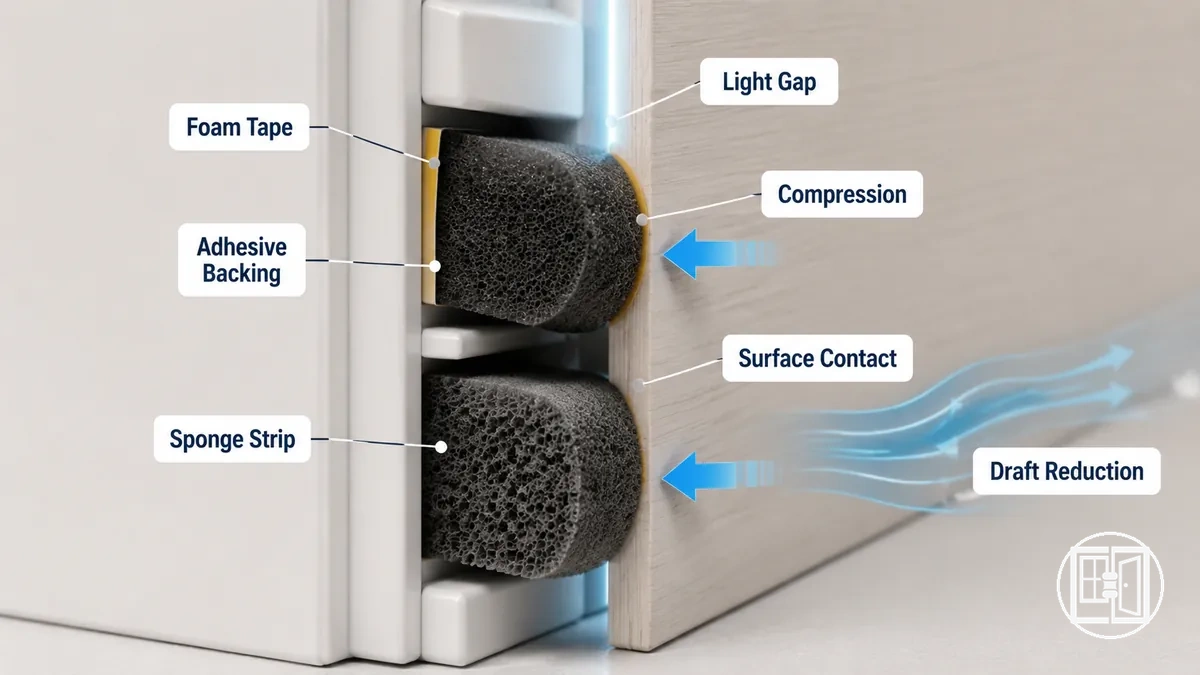
Foam tape works as a compressible seal through its foam structure, where thickness and material density influence how it reacts to surface contact. A sponge seal strip behaves similarly but may show more variation in compression depending on structure, which affects how consistently it fills small irregularities in a frame gap. In both cases, adhesive backing determines how well the strip holds to the surface, and performance can vary with surface contact quality, dust exposure, or uneven adhesion conditions.
In a narrow window or door gap, a foam strip or sponge strip can provide controlled soft sealing when rigid profiles cannot align properly with the frame. In such cases, compression helps reduce drafts, although the result still depends on how stable the contact pressure remains over repeated opening and closing cycles.
Rubber, Silicone, and EPDM Compression Seals
Rubber seal, silicone seal, and EPDM are compression seal types that form a flexible profile around doors and windows. These materials create sealing through contact pressure against a frame in moving door and moving window applications.
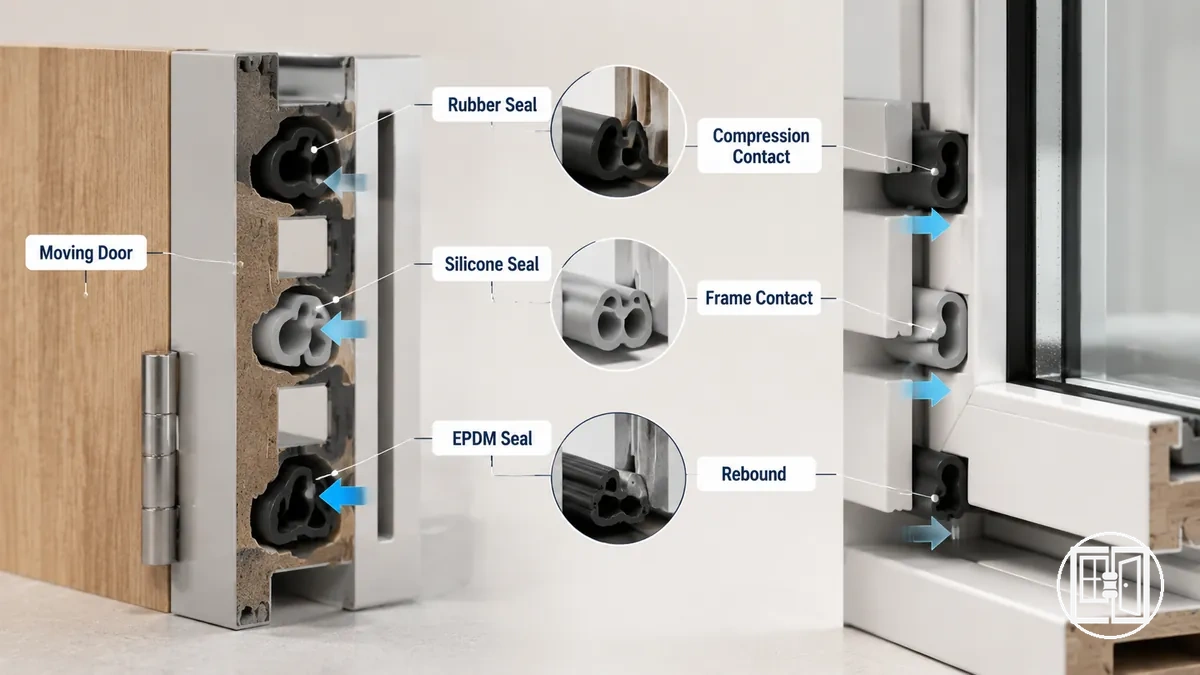
The sealing effect depends on rebound, profile shape, and contact pressure as the door or window closes against the frame. Rubber seal materials typically compress under pressure and recover their shape after movement, while silicone seal variations can maintain flexibility under repeated contact cycles. EPDM behaves as a weather-resistant compression profile where stable frame contact is maintained under varying movement conditions.
These compression seals are often confused with foam tape or sponge strips, but they rely more on structured rebound and controlled contact pressure rather than soft open compression, which changes how they behave in moving frame systems. For deeper material differences across sealing families, see the materials comparison.
V-Strip and Tension Seal Profiles
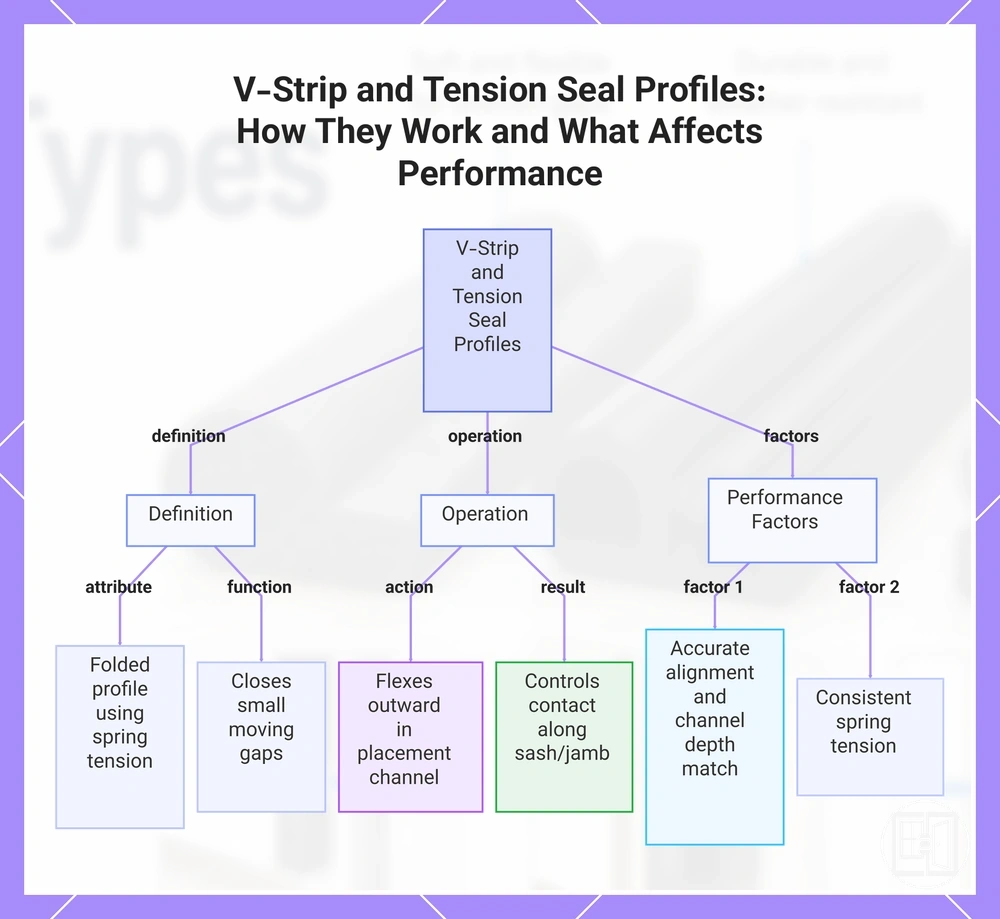
V-strip and tension seal profiles are folded profile elements that use spring tension to close small moving gaps in doors and windows. The V-strip shape flexes outward inside a placement channel, allowing controlled contact along a sash or jamb under movement.
These tension seal profiles depend on accurate alignment within the placement channel along the sash and jamb to maintain steady sealing in a small moving gap. Performance is influenced by how well the folded profile matches the channel depth and how consistently spring tension is maintained during movement across the joint. When alignment is off, even a correct V-strip type can reduce sealing effectiveness because contact pressure becomes uneven along the edge of the frame.
This chart explains the definition, operating mechanism, and critical performance factors of V-strip and tension seal profiles used in doors and windows.
Tubular, Bulb, and Kerf-In Profiles
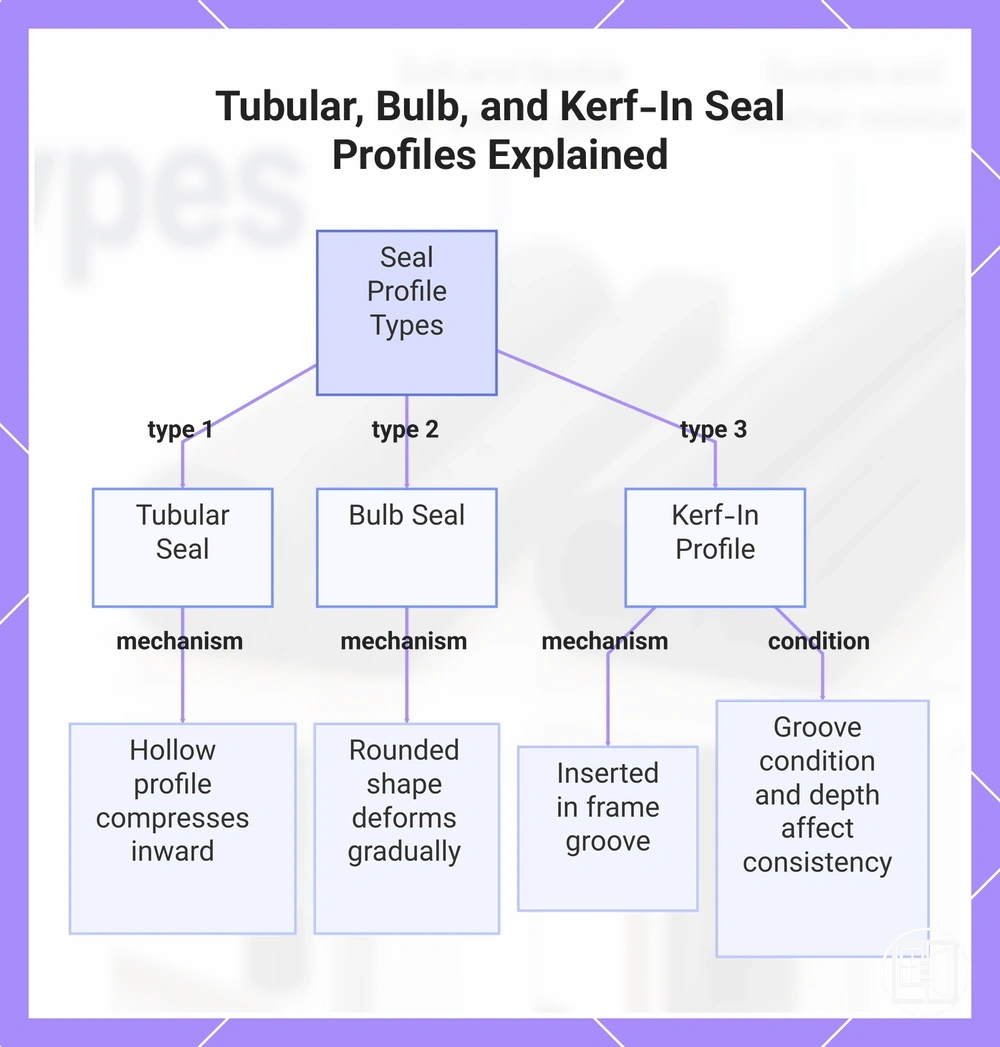
Tubular seal, bulb seal, and kerf-in profile are shaped seal types that compress along a defined contact path to control movement-based gaps in doors and windows. These profiles differ in how their shape interacts with a frame groove and closing pressure rather than relying only on surface contact.
Tubular seal uses a hollow profile that compresses inward along the contact path as closing pressure increases, while bulb seal uses a rounded shape that deforms gradually to fill the sealing zone against the frame stop. Kerf-in profile is an inserted seal that sits within a frame groove, where compression depth and groove condition influence how consistently the seal follows the contact path during movement. Each profile behaves differently depending on how the frame groove is formed and how the closing pressure is distributed.
These profiles are commonly found in doors or windows with existing frame grooves or predictable closing pressure, but suitability can vary when groove depth or alignment does not match the inserted or shaped seal design.
This chart shows the three main types of shaped seal profiles—tubular, bulb, and kerf-in—and their key behavioral characteristics based on shape, groove interaction, and closing pressure.
Adhesive-Backed Weather Stripping Tapes
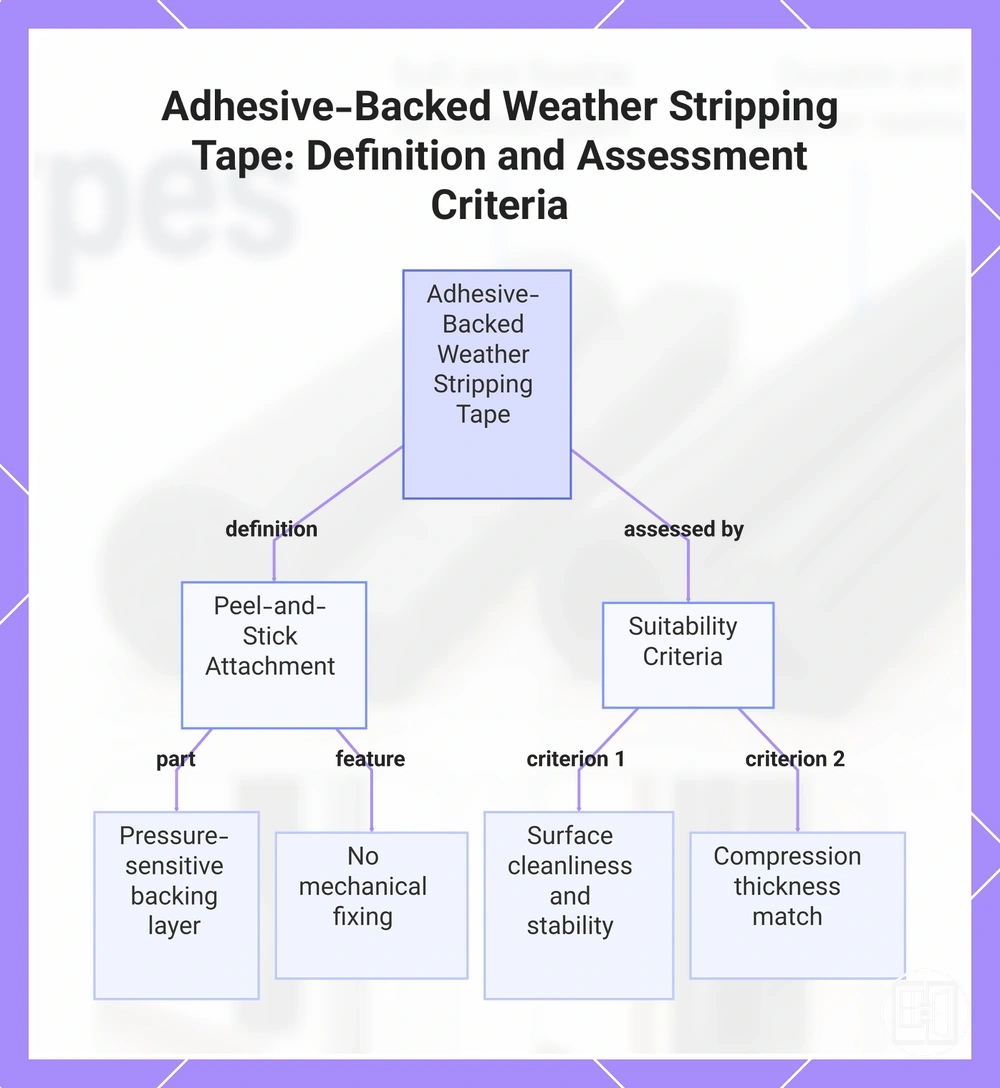
Adhesive-backed tape is a weather stripping attachment format defined by peel-and-stick backing rather than the seal material itself. The adhesive-backed tape uses a pressure-sensitive backing layer to attach foam, rubber, or other strip types to a frame surface without mechanical fixing methods. Its function is determined by attachment behavior rather than the sealing material’s shape alone.
Suitability depends on backing condition, surface cleanliness, compression thickness, and exposure condition around the frame. A clean and stable surface can reduce adhesion risk, while dust, moisture, or uneven coatings may affect suitability and long-term bond stability. Compression thickness must also match the gap, since mismatch can reduce consistent surface contact and sealing continuity.
Adhesive-backed weather stripping depends on both seal shape and surface condition, and it can be assessed using key criteria:
- Surface cleanliness and stability of the application area
- Compression thickness relative to the gap size
- Exposure condition such as moisture or temperature variation
- Level of movement or repeated opening in the contact area
- Condition of existing paint or coating on the frame
Adhesive format is an attachment method and may appear across foam, rubber, and other weather stripping types rather than being a standalone material category.
This chart explains the definition of adhesive-backed weather stripping tape and the key criteria for assessing its suitability.
Magnetic Door Seal Strips
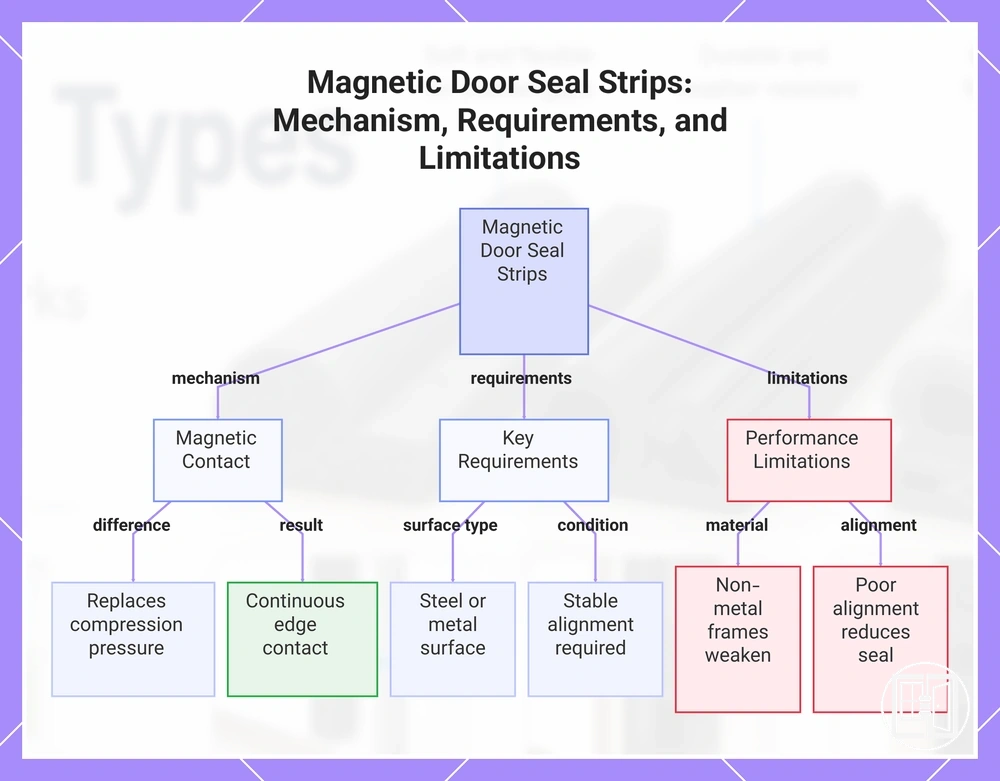
Magnetic door seal strip is a sealing type that relies on magnetic contact rather than compression or peel-and-stick attachment. The magnetic contact forms when a compatible receiving surface, such as a steel door or metal frame, aligns with the strip so the closing surface can maintain continuous edge contact. The sealing effect depends on stable alignment and a suitable receiving surface, while incompatibility may occur when the door material does not support magnetic attraction.
Magnetic door seal strips depend on the relationship between the magnetic strip, receiving surface, and closing surface, where alignment determines whether a continuous seal path can form. In steel door applications, magnetic contact can support consistent edge sealing when positioning is correct, but non-metal frames or poorly aligned surfaces may reduce sealing performance due to weak or absent attraction. In such cases, the system cannot maintain stable contact because the magnetic force is not supported by the material interface.
Magnetic contact differs from compression seals because it does not rely on material deformation under pressure, but on attraction between compatible surfaces to maintain closure behavior.
This chart explains how magnetic door seal strips work, what they require for proper sealing, and the limitations that affect their performance.
Felt, Pile, Vinyl, and Metal Strip Options
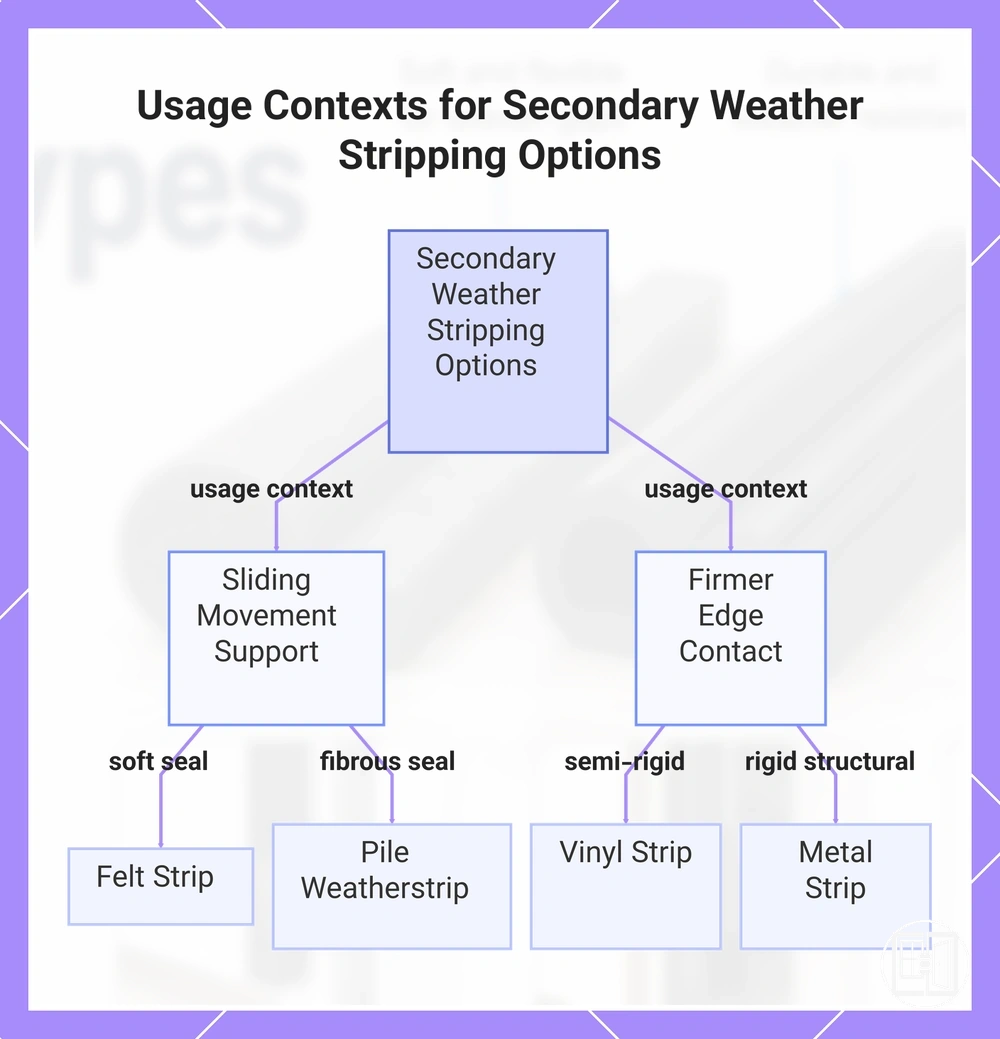
Felt strip, pile weatherstrip, vinyl strip, and metal strip are secondary weather stripping options used in specific frame and sash contexts where controlled movement or light sealing is required. These options are defined mainly by texture, rigidity, and movement tolerance rather than compression sealing performance, and they typically support sliding movement or guide contact within frame systems.
These options differ in how texture, rigidity, movement tolerance, and placement affect their use in sash channel or edge-based movement systems:
- Felt strip: A soft texture option with low rigidity and limited movement tolerance, typically used for light contact and dust reduction in low-pressure frame gaps where sliding movement is minimal.
- Pile weatherstrip: A fibrous seal used in sash channel applications, offering moderate movement tolerance and supporting controlled sliding movement while reducing air and dust transfer.
- Vinyl strip: A semi-rigid option with higher rigidity than felt or pile, used for frame contact areas where fit stability and moderate movement tolerance are required.
- Metal strip: A rigid strip with structural stiffness and limited flexibility, used in edge or frame conditions where defined movement tolerance and durability are more relevant than soft sealing.
In sliding movement systems such as sash channel windows, pile and felt strips are more commonly used to support guided movement, while vinyl and metal strips are applied where firmer edge contact or structural alignment is needed.
This chart categorizes secondary weather stripping options by their primary usage context in frame and sash systems.
How Each Seal Type Blocks Drafts and Air Movement
Seal mechanism blocks drafts and air movement by maintaining contact across a gap condition between moving and fixed frame surfaces. This sealing action depends on how compression, tension, or magnetic closure maintains contact under a given frame condition, rather than on the seal name alone.
Draft control depends on how each seal mechanism sustains contact through compression, tension, or magnetic closure under specific gap condition and frame condition. The interaction between contact method and surface alignment determines how air movement is reduced in practical use. A structured breakdown of these mechanisms is shown below for clarity. You can also compare this with the broader weather stripping overview for context on how sealing systems are categorized.
| Mechanism | Seal types that use it | Gap condition | What can make it fail |
|---|---|---|---|
| Compression | Foam, rubber, tubular, bulb seals | Fixed closing frame pressure gaps | Insufficient contact or uneven frame condition reducing sealing action |
| Tension | V-strip, pile weatherstrip in channels | Sliding movement along sash channel gaps | Misalignment or disrupted sliding movement affecting contact continuity |
| Magnetic closure | Magnetic seal strips | Compatible receiving surface contact gaps | Non-compatible receiving surface or poor alignment reducing contact |
A mismatch between seal mechanism and gap condition can reduce draft control effectiveness. For example, using a tension-based seal in a non-sliding frame condition may interrupt contact, allowing air movement to persist. In such cases, performance depends on correct alignment between compression, tension, or magnetic closure and the actual frame condition rather than the seal type alone.
Compression Against the Frame
Compression against the frame refers to a seal mechanism where the seal is squeezed between the moving part and the frame, creating controlled contact under pressure level that reduces air movement. This describes how compression works through direct contact rather than sliding alignment, with performance depending on gap depth and how evenly the seal sits in the frame.
Pressure level controls how strongly the compression acts between the moving part and the frame, influencing contact continuity along the sealing edge. Rebound affects how quickly and consistently the material returns after closing, especially across different gap depth conditions in the frame. Closing resistance may increase when compression is uneven or when frame condition causes irregular pressure distribution. Over-compression can affect operation of the moving part and may shorten seal usefulness depending on frame condition.
Spring Tension Across a Gap
Spring tension across a gap refers to a sealing mechanism where a flexible profile applies spring force outward to maintain contact within a narrow moving gap between the moving part and the frame. This spring tension creates pressure without full compression, allowing the seal to adapt to movement while staying engaged with the frame surface.
Gap width influences how effectively spring tension maintains contact, since the flexible profile must remain within a narrow moving gap to sustain sealing reliability. Alignment between the frame and moving part affects how evenly spring force distributes along the movement path, which supports stable contact continuity during motion. Sealing reliability can reduce when the movement path is misaligned or when gap width exceeds the intended tension range. Unlike soft foam compression, spring tension relies on outward pressure rather than full material squeeze, which changes how the seal responds to frame conditions.
Magnetic Contact on Steel Doors
Magnetic contact on steel doors refers to a sealing mechanism where magnetic contact forms between a flexible sealing element and a compatible metal surface through a receiving strip. This magnetic contact depends on attraction to the steel door or receiving strip rather than compression between frame surfaces, creating a controlled closing interaction along the sealing line.
Alignment between the steel door and the receiving strip determines how consistently magnetic contact is distributed across the closing contact path. Magnet strength directly affects seal continuity, since stronger attraction can maintain more stable contact along the compatible metal surface during repeated movement. When alignment is correct, the receiving strip supports continuous closing contact, but reduced magnet strength may interrupt seal continuity over time. In cases where paint layers build up on the compatible metal surface, or where misalignment and non-compatible surface conditions occur, magnetic contact may weaken and reduce sealing reliability due to inconsistent attraction points.
Where Different Weather Stripping Types Usually Fit
Fit location for weather stripping depends on location, movement type, and gap behavior rather than a universal placement rule. Door frame and window frame conditions create different sealing demands, so seal form changes based on how each fitting point moves and how the gap behaves during closing or sliding action.
Different weather stripping types fit different frame areas because movement type and gap behavior vary across a door frame and window frame. The table below maps common fit locations with their typical seal form and key compatibility condition for clearer interpretation of where each type usually aligns.
| Location | Movement type | Likely seal form | Key caution |
|---|---|---|---|
| Door frame perimeter | Closing pressure movement | Compression-based seals | Consistency of gap behavior affects compatibility condition |
| Bottom gap / threshold | Impact + contact closure | Bulb or tubular forms | Uneven threshold can reduce sealing consistency |
| Window sash channel | Sliding movement | Pile or tension profiles | Alignment inside channel affects seal reliability |
| General frame area | Light movement or fixed contact | Foam or adhesive-backed strips | Surface condition affects adhesion and fit location stability |
In many cases, the same seal form can behave differently depending on whether it is used on a door frame or window frame because movement type and gap behavior are not identical. This variation makes fit location more important than assuming universal compatibility across all fitting points. This is why users often rely on a selection guide when comparing compatibility conditions across different sealing scenarios.
Door Perimeters, Bottom Gaps, and Kerfed Frames
Door perimeter, bottom gap, and kerfed frame compatibility depends on how the gap is formed, how the door moves, and whether a groove is available for insertion. Seal type performance changes across these areas because door perimeter sealing relies on closing pressure, bottom gaps respond to threshold condition and gap direction, and kerfed frames depend on groove availability for a stable inserted profile.
Door-area fit varies based on closing pressure, gap direction, groove availability, and threshold condition, which together determine the suitable seal family for each position. Door perimeter and side jamb areas typically rely on compression from closing pressure, while bottom gap areas are more sensitive to threshold condition because clearance and gap direction change under movement. Kerfed frames introduce a different constraint where groove availability determines whether an inserted seal can maintain stable alignment inside the channel.
- Door perimeter: Depends on closing pressure along side and top jambs where compression must remain consistent across the door edge.
- Bottom gap: Driven by threshold condition and gap direction where clearance changes affect sealing continuity and may require a different seal form than perimeter areas.
- Kerfed frame: Defined by groove availability in the kerfed frame channel where inserted profiles depend on channel fit and alignment stability.
A key decision signal is that a bottom gap often requires a different seal form than a side or top jamb because threshold condition and gap direction change how contact is maintained during closing, unlike perimeter areas where closing pressure is the dominant factor.
Window Sashes, Channels, and Moving Joints
Window sash compatibility depends on how the window sash moves within the channel and how the moving joint maintains controlled contact through available space and surface conditions. Window sash behavior is shaped by movement path, channel depth, and sash clearance, which together determine how seal behavior adapts without restricting normal operation. Seal performance must balance surface contact with continuous movement across the joint area. :contentReference[oaicite:0]{index=0}
Window fit conditions depend on movement path, channel depth, sash clearance, and surface contact across the moving joint. A deeper channel can support more stable seal behavior, while limited channel depth may restrict how consistently contact is maintained. Sash clearance directly affects how freely the window moves, so compatibility depends on maintaining balance between contact pressure and unrestricted movement. Surface contact conditions influence whether seal behavior remains stable during repeated movement cycles, especially in tighter channel configurations. A key caution is that the seal must preserve normal sash movement while still reducing air gaps across the channel area.
- Movement direction: Determines how the window sash travels within the channel and affects contact consistency.
- Channel space: Defines available room for seal behavior and influences compression or glide performance.
- Contact surface: Controls how consistently seal behavior aligns with the moving joint.
- Normal operation: Must remain smooth without restricting sash movement during repeated use.
Type Differences That Affect Weather Stripping Choice
Weather stripping choice depends on decision attribute differences such as gap size, compression range, surface contact, movement tolerance, and durability conditions rather than a single universal best type. Each type behaves differently under specific conditions, so suitability changes based on how these attributes interact with real installation and usage environments.
Type differences matter because gap size, surface contact, and movement behavior change how sealing performance develops in practice. The comparison below organizes key decision attributes to show how trade-offs shape suitability instead of implying a fixed or universal outcome across all applications.
| Decision attribute | What to check | Type behavior | What it affects |
|---|---|---|---|
| Gap size | Width and consistency of opening | Different seal profiles respond to different gap ranges | Fit stability and sealing suitability |
| Compression range | Material response under closing pressure | Foam, rubber, and tension-based types behave differently | Contact reliability and sealing consistency |
| Surface contact | Condition and alignment of contact area | Adhesive and channel-based systems depend on surface quality | Adhesion risk and seal continuity |
| Movement tolerance | Sliding or repeated motion level | Channel-based and pile types handle motion differently | Wear rate and operational smoothness |
| Durability conditions | Exposure to pressure cycles and environmental stress | Structure and material rigidity influence long-term behavior | Maintenance needs and suitability over time |
Weather stripping choice is best understood by comparing decision attributes rather than selecting a single best type. For broader context on how material behavior influences these attributes, see materials comparison. This helps connect structural differences to real performance trade-offs across different gap conditions.
For practical decision-making, these attributes should be evaluated together rather than in isolation. The selection guide shows how these trade-offs align with specific usage scenarios and installation constraints.
Gap Size and Compression Range
Gap size and compression range determine whether a seal type can properly close a specific opening, since the seal must compress enough to fill the measured width without creating excessive closing resistance during operation. The fit result depends on how seal thickness aligns with compression range and how the material responds under operating pressure, making this a key criteria-based decision for weather stripping choice. :contentReference[oaicite:0]{index=0}
Measured width defines the actual gap size, while seal thickness determines how much material is available to fill that space under compression. Compression allowance describes how much the seal can safely deform under operating pressure, which directly affects whether the result is smooth closure or increased closing resistance. When a seal is oversized relative to the gap size, closing resistance may increase and affect normal movement, while an undersized seal may fail to maintain contact and allow drafts. These trade-offs depend on how compression range interacts with real installation conditions rather than a fixed universal fit.
- Measure: Check measured width against the gap size before selecting seal thickness
- Match: Ensure seal thickness aligns with available compression range
- Compress: Confirm compression allowance under expected operating pressure
- Test conceptually: Evaluate whether closing resistance or draft risk is more likely in the fit result
Surface Contact and Adhesive Suitability
Surface contact and adhesive suitability determine whether a seal can maintain reliable attachment or consistent touch across a surface, since adhesive-backed or contact-dependent seals require a stable surface and even contact path to achieve sealing reliability. Adhesion reliability and sealing reliability depend on how well the surface supports continuous contact under real use conditions. :contentReference[oaicite:0]{index=0}
Cleanliness affects whether adhesive suitability can develop properly, as dust or residue can interrupt surface contact and reduce adhesion reliability. Texture influences how evenly the seal can sit against the surface, while flatness controls whether the contact path remains continuous or uneven during use. Paint condition also plays a role because coatings can either support or weaken adhesion depending on their stability, and movement along the contact path can further affect long-term sealing reliability. In practice, adhesive suitability is one part of the broader decision process, not the only factor defining overall seal selection.
- Clean surface: Ensures stable surface contact for adhesion reliability
- Even contact path: Supports consistent sealing reliability across the surface
- Paint condition: Influences how well adhesive bonds remain stable
- Movement: Can reduce long-term contact stability depending on usage
- Exposure: Environmental conditions may affect adhesive suitability over time
Durability, Flexibility, and Movement Tolerance
Durability, flexibility, and movement tolerance determine how a weather stripping type performs under repeated use, where durability is shaped by wear exposure and flexibility controls how the seal responds to ongoing movement rather than a fixed lifespan. Movement tolerance must align with repeated use so the seal can maintain contact without increasing maintenance pressure or raising replacement pressure under stress. :contentReference[oaicite:0]{index=0}
Flexibility affects how the seal adapts to compression and release cycles, while rebound behavior determines how consistently it returns after repeated use. Wear exposure and movement frequency directly influence durability, especially in conditions where contact happens often across opening and closing cycles. In lower movement areas, maintenance pressure may remain stable, while higher activity zones increase the impact of flexibility limits on sealing reliability over time.
High-use doors and sliding windows place stronger demand on movement tolerance because repeated use increases wear exposure and can accelerate replacement pressure when flexibility and rebound behavior are not aligned with the motion pattern. Low-movement gaps typically experience reduced stress, where durability is influenced more by environmental exposure than frequent mechanical cycling.
| Criterion | What changes | Why it matters |
|---|---|---|
| Durability | Wear exposure and movement frequency | Affects maintenance pressure over repeated use |
| Flexibility | Rebound behavior during compression cycles | Controls sealing consistency under motion |
| Movement tolerance | Response to repeated use conditions | Determines suitability for high or low activity gaps |
When a Weather Stripping Type Is the Wrong Match
A wrong match in a weather stripping type usually occurs when the profile, gap, surface, or movement pattern does not align with the required condition, creating a mismatch condition that shows up as performance limitation or inconsistent sealing behavior. In most cases, the seal type is unsuitable because the core fit variables do not align with the real installation context.
Mismatch signals can be organized to reflect their cause so they can be interpreted as a decision cue rather than isolated faults. These signals typically relate to seal type, profile, gap, surface, or movement pattern and indicate where selection logic may not align with actual use conditions.
| Mismatch sign | Likely cause | What to check next |
|---|---|---|
| Remaining draft | Profile and gap mismatch | Gap size and seal profile alignment |
| Closing resistance | Oversized profile or surface pressure mismatch | Surface contact and compression level |
| Uneven sealing line | Movement pattern or surface inconsistency | Movement pattern and installation alignment |
| Local contact loss | Surface or frame inconsistency | Surface condition and profile fit |
These mismatch conditions should be treated as boundary indicators that the current type may not align with selection logic rather than problems to be fully diagnosed in isolation. When they appear, they typically point toward a broader evaluation of profile, gap, surface, and movement pattern using structured selection logic such as the selection guide.