
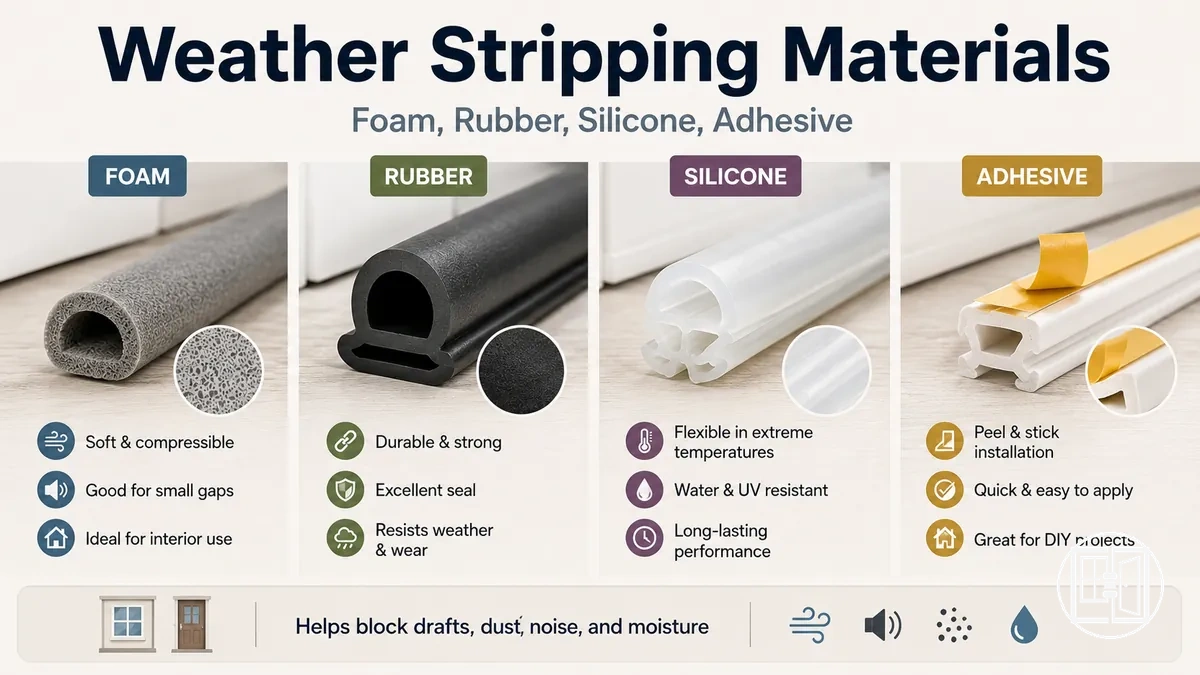
Weather stripping materials compared for doors and windows
Weather stripping materials refer to different sealing options used around doors and windows to influence fit, compression, durability, and sealing outcome. Each material changes how a seal behaves under pressure, movement, and surface contact, which means performance depends on conditions rather than a universal result. Foam, rubber, silicone, vinyl, felt, and metal each respond differently to compression and wear, shaping how effectively they support a stable door seal or window seal over time.
The comparison depends on real-world conditions such as gap size, frame surface condition, exposure to moisture or temperature changes, and how frequently doors or windows are used. A lightly used interior gap may require different sealing strips compared to an exterior door exposed to repeated opening and closing. These variables determine how material choice affects compression behavior, rebound, fit, and overall sealing outcome.
This section compares weather stripping materials rather than explaining installation steps or presenting product listings. The focus stays on how each material option performs under different conditions instead of how to apply or replace them. This keeps the analysis centered on decision factors such as durability, fit, and sealing outcome.
Understanding these material differences begins with how each option responds to compression and contact pressure in door and window applications.
Material properties that change weather stripping behavior
Material properties in weather stripping define how sealing strips compress, rebound, and maintain contact across doors and windows. These properties directly influence flexibility, surface grip, wear resistance, and overall sealing outcome under real use conditions. Differences in compression behavior and gap conformity determine how effectively a material maintains fit over time rather than delivering a uniform result in every situation.
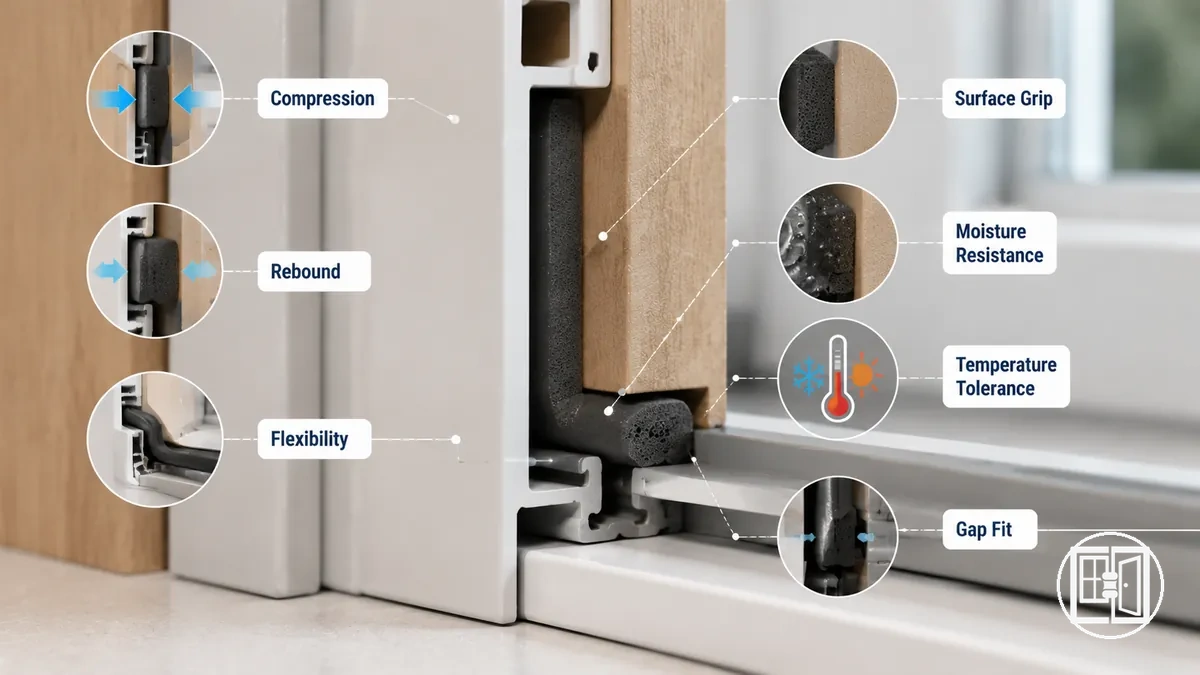
These properties can be grouped into mechanical response, environmental resistance, and surface interaction. Mechanical response includes how materials compress and recover shape under closing force, while environmental resistance relates to moisture resistance and temperature tolerance across exposure conditions. Surface interaction focuses on how well the strip maintains surface grip against different frame conditions, paint finishes, and movement patterns in doors and windows.
Material performance differences depend on how these properties interact with frame condition, gap size, and usage frequency. Soft compressible materials may respond better to light, uneven gaps, while denser flexible options can maintain stability under repeated contact pressure. These differences should be interpreted as conditional behavior rather than universal performance rules.
Key properties that shape weather stripping behavior include:
- Compression — controls how the material reacts to closing force and how tightly it seals the gap
- Rebound — determines how well the material returns to shape after repeated compression cycles
- Flexibility — affects how the strip adapts to frame movement and irregular surfaces
- Surface grip — influences adhesion and contact stability on different frame finishes
- Moisture resistance — impacts performance in damp or exposed environments
- Temperature tolerance — affects stability under heat or cold exposure over time
- Wear resistance — determines durability under repeated use and friction
- Gap conformity — defines how well the material adapts to varying gap shapes and sizes
Foam, rubber, silicone, vinyl, felt, and metal weather stripping
Each weather stripping material family performs differently because foam, rubber, silicone, vinyl, felt, and metal respond in distinct ways to fit, compression behavior, durability, and exposure conditions. These differences influence how each weather seal option performs across doors and windows where gap size, movement, and surface condition vary. The comparison is based on these shared criteria rather than ranking any material as universally superior.
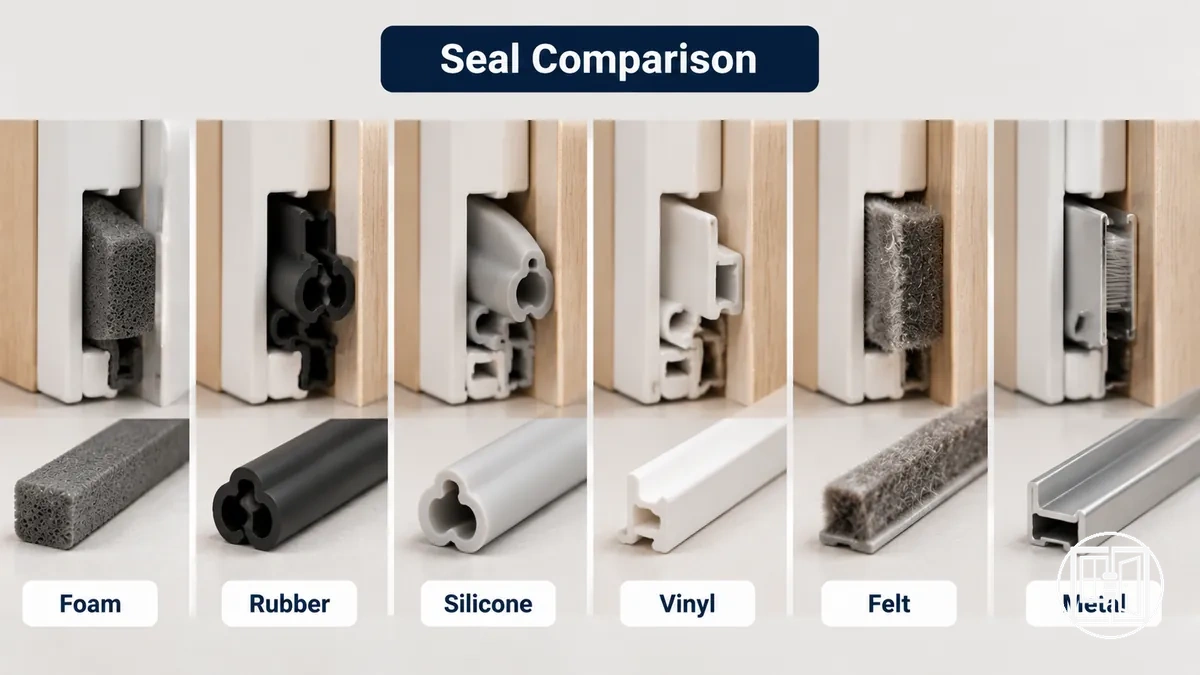
This comparison focuses on how each material family behaves under real conditions. Foam and felt typically support compressible sealing for light gaps, rubber and vinyl provide flexible sealing for everyday door and window movement, while silicone and metal tend to support higher stability under exposure and repeated use. The table below organizes these differences by material family and practical sealing role. Each row represents a material family rather than a specific product type.
| Material family | Typical strengths | Common limits | Better fit conditions |
|---|---|---|---|
| Foam | Compressible, adapts to light pressure | Lower wear resistance under frequent use | Small gaps, low movement doors or windows |
| Felt | Soft contact, simple gap filling | Limited moisture and compression resistance | Low-exposure interior gaps |
| Rubber / EPDM | Balanced flexibility and compression behavior | May stiffen under long-term exposure changes | Regular-use doors and windows |
| Silicone | Stable under exposure and temperature variation | Higher material rigidity in tight fitting gaps | Exterior doors and variable climates |
| Vinyl | Flexible sealing with moderate durability | Can deform under repeated compression cycles | General household door and window use |
| Metal | High structural stability and long-term form retention | Less adaptable to irregular gaps | Consistent frame alignment and rigid structures |
Seal type and material family can overlap in practice, but they are not identical decisions because performance depends on how fit, compression behavior, durability, and exposure tolerance interact in real door and window conditions. Choosing between foam, rubber, silicone, vinyl, felt, and metal always depends on how these factors combine rather than a fixed material hierarchy. Source: :contentReference[oaicite:0]{index=0}
Foam and felt for low-cost compressible gaps
Foam and felt are low-cost weather stripping materials used for compressible gaps where light draft sealing is the main requirement. They perform best in low-friction, low-movement door and window conditions rather than exposed or high-contact areas, so suitability depends on surface condition and gap behavior.
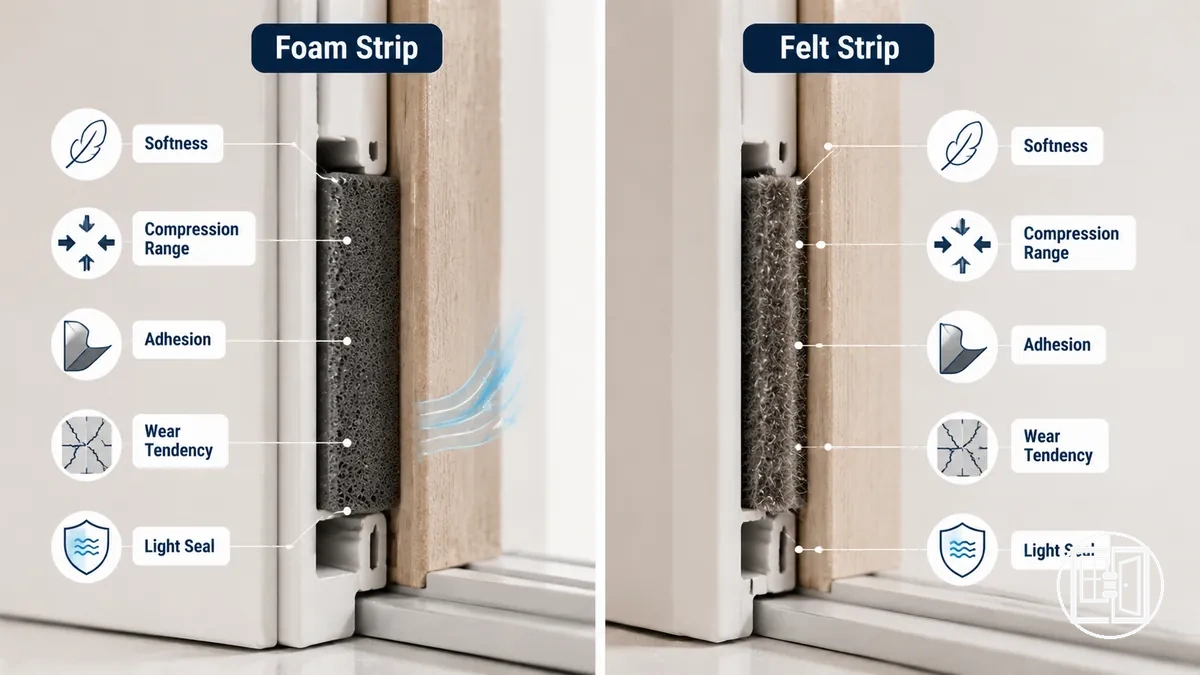
The performance of foam and felt depends on softness, compression range, adhesion dependence, and wear tendency. Foam usually provides a wider compression range for uneven light gaps, while felt relies more on surface contact stability and can wear faster under repeated movement. Both support light draft sealing, but lifespan is limited when exposure or friction increases, so durability expectations remain condition-based.
- Foam softness — adapts to irregular light gaps with flexible compression range
- Felt contact — supports low-friction interior sealing with basic surface contact
- Adhesion dependence — performance may reduce on dusty, painted, or damp surfaces
- Wear tendency — increases under frequent movement and edge friction
- Light draft sealing — suitable for minor air gaps under low exposure conditions
Rubber, EPDM, and vinyl for flexible everyday sealing
Rubber, EPDM, and vinyl are flexible sealing materials used in everyday weather stripping when contact pressure, gap shape, and movement frequency align with their performance range. They support flexible sealing where doors and windows experience repeated movement and require consistent rebound rather than rigid sealing behavior.
Rubber, EPDM, and vinyl differ in rebound, compression memory, moisture tolerance, and use frequency response. Rubber typically provides stable rebound under repeated contact pressure, helping maintain sealing shape during frequent movement. EPDM tends to perform better under higher moisture tolerance conditions, especially in exposed environments where weather variation affects material stability. Vinyl supports flexible sealing in lighter to moderate use cases where compression memory demands are lower and frame movement is less intense. All three depend on correct matching of contact pressure and frame conditions rather than universal suitability.
| Material | Flexibility & Rebound | Moisture Tolerance | Typical Use Condition |
|---|---|---|---|
| Rubber | Balanced flexibility with consistent rebound | Moderate depending on exposure | Frequent door movement and stable contact pressure |
| EPDM | High flexibility with stable compression memory | Higher resistance to moisture exposure | Exterior doors with variable weather conditions |
| Vinyl | Moderate flexibility for lighter movement | Basic moisture tolerance in controlled environments | Interior or low-to-moderate use frames |
In practical use, rubber, EPDM, and vinyl selection depends on how often the seal is compressed and how much environmental exposure it receives. When use frequency is high, rubber or EPDM may maintain shape better under repeated movement, while vinyl may suit lighter sealing conditions with lower contact stress.
Silicone and metal for longer service life and exposure resistance
Silicone and metal are used in weather stripping when longer service life and exposure resistance are required under sustained temperature, moisture, and contact conditions. Their performance depends on how well the seal matches frame contact and movement patterns rather than acting as universally durable solutions.
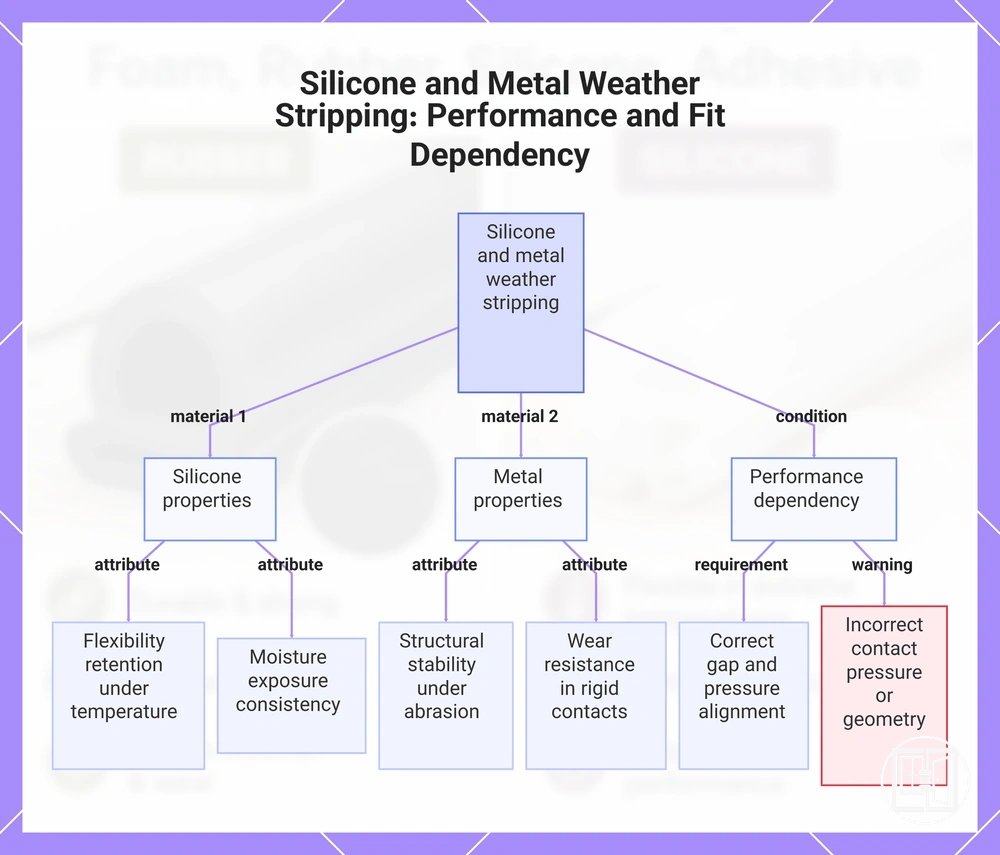
Silicone typically supports flexibility retention under temperature exposure, while metal maintains structural stability under repeated frame contact and abrasion. Silicone may handle moisture exposure more consistently in variable conditions, while metal can resist wear in rigid contact zones where abrasion is higher. In both cases, performance depends on correct gap profile and pressure alignment, and durability can reduce when the fit is incorrect rather than due to material alone.
An edge case occurs when silicone or metal is applied outside suitable contact pressure or frame geometry. In such situations, even exposure-resistant materials may show reduced effectiveness because sealing conditions do not support proper interaction between material and frame contact.
This chart shows how silicone and metal weather stripping materials provide service life and exposure resistance, and why their performance depends on correct frame fit and pressure alignment.
Adhesive-backed strips versus compression seals
Adhesive-backed strips depend on attachment method and surface hold, while compression seals depend on gap pressure and rebound to maintain sealing performance. These two formats define how material performance is realized under movement and frame conditions, making the distinction primarily about format behavior rather than material alone.
Adhesive-backed strips rely on surface preparation and bonding quality, while movement and moisture exposure can influence long-term stability. Compression seals rely on controlled gap pressure and rebound, where consistent frame contact determines sealing behavior over time. In both cases, failure risk increases when surface condition or pressure alignment does not match the intended format under repeated movement.
Adhesive-backed strips and compression seals can overlap in application because some materials are available in both formats depending on design. This means material performance is shaped by both composition and attachment method, so the boundary between adhesive and compression systems is not always strict.
| Format | What controls performance | Common failure risk | Better fit condition |
|---|---|---|---|
| Adhesive-backed strips | Surface preparation and bonding hold | Reduced adhesion under moisture or movement stress | Smooth, stable surfaces with limited disturbance |
| Compression seals | Gap pressure and rebound behavior | Poor sealing when pressure or alignment is inconsistent | Uniform gaps with stable frame contact pressure |
Adhesive backing depends on surface hold and preparation
Adhesive backing depends on surface hold and surface preparation rather than the adhesive strip alone. Adhesive backing only performs reliably when the bonding surface provides stable contact conditions for consistent surface hold.
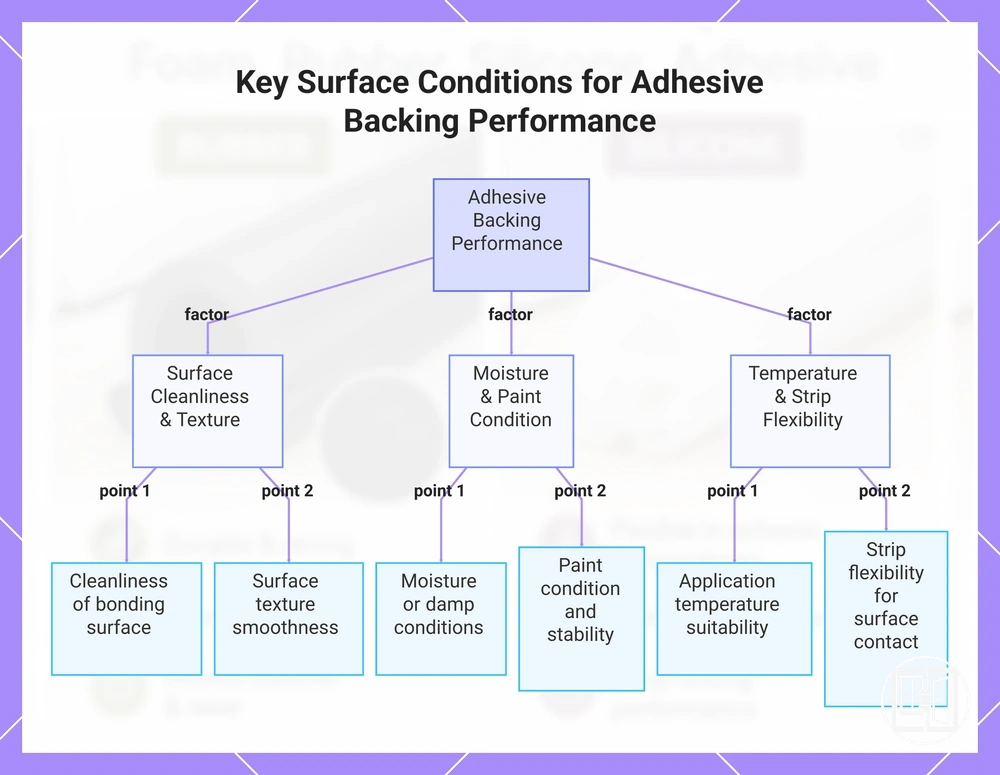
Surface cleanliness, texture, moisture, paint condition, application temperature, and strip flexibility all affect adhesive backing performance. Clean, smooth surfaces typically improve surface hold, while dusty, damp, or unstable paint conditions can reduce bonding reliability. The same adhesive strip may behave differently across smooth, textured, painted, or damp frames due to these conditions, changing material performance without changing the strip itself.
Surface conditions checklist:
- Cleanliness of the bonding surface
- Surface texture and smoothness
- Moisture presence or damp conditions
- Paint condition and stability
- Application temperature suitability
- Strip flexibility for surface contact
This chart groups the surface conditions that affect adhesive backing reliability into three main factors, based on the section's checklist.
Compression seals depend on gap pressure and rebound
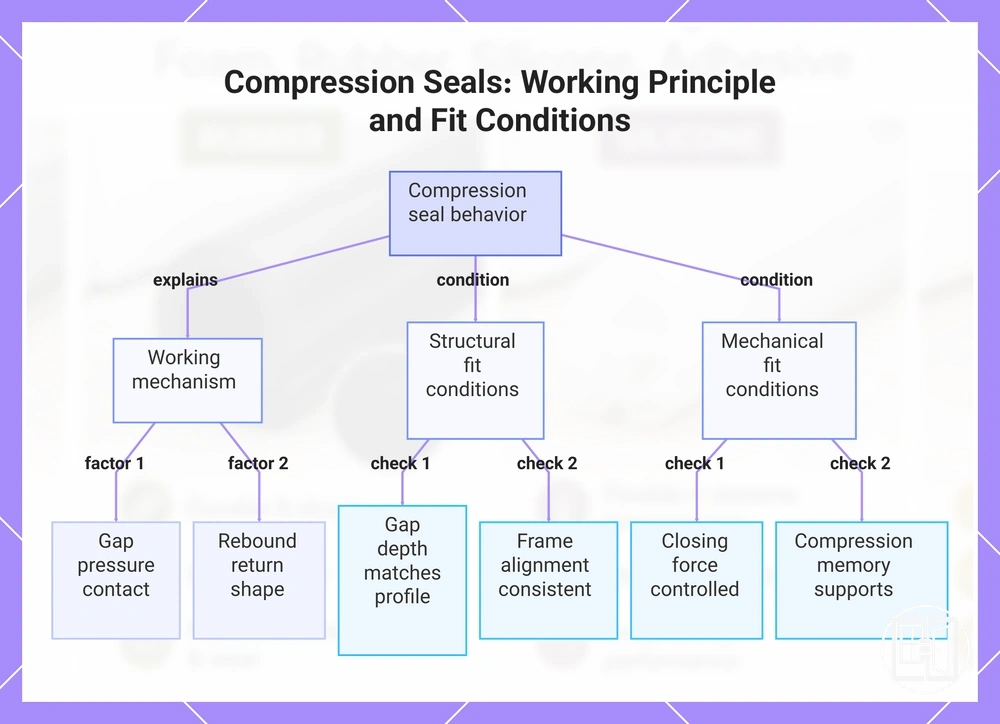
Compression seals depend on gap pressure and rebound rather than material strength alone. Compression seals work when gap pressure and rebound remain within a controlled range, allowing the seal to return to shape after contact and maintain consistent sealing behavior.
Gap depth, closing force, profile thickness, compression memory, and frame alignment influence how compression seals perform in real use. Under-compression occurs when gap pressure is too low for proper contact, while over-compression happens when closing force exceeds the material’s rebound capacity. A correct compression fit is achieved when compression seals deform evenly and recover without lasting distortion under repeated contact.
Compression fit conditions checklist:
- Gap depth matches profile thickness for balanced gap pressure
- Closing force allows controlled compression without excessive strain
- Compression memory supports repeated rebound after contact cycles
- Frame alignment maintains consistent contact along the sealing path
This chart shows the core working principle of compression seals and the key conditions for a correct compression fit.
Durability and lifespan differences by weather stripping material
Durability and lifespan of a weather stripping material vary by material type and usage conditions rather than a fixed ranking. Lifespan depends on exposure, friction, compression, and maintenance context, so durability should be treated as conditional across different applications.
The main durability stressors include wear from repeated use cycles, cracking under UV exposure or temperature exposure, flattening from sustained compression, adhesive fatigue caused by surface condition changes, and moisture influence on bonding and material stability. Use frequency increases mechanical stress and can accelerate these failure patterns, with each stressor leading to a different form of material wear rather than a single uniform breakdown mode.
Long-term performance should be interpreted as a balance between material choice and environmental conditions rather than a guaranteed lifespan outcome. In many cases, higher durability materials may be preferred when exposure or use frequency is higher, but suitability still depends on matching conditions to application needs.
| Weather stripping material | Main stressor | Likely wear pattern | Decision implication |
|---|---|---|---|
| Foam | Compression and moisture exposure | Flattening and reduced rebound | Suitable for low-use, low-exposure sealing |
| Rubber / EPDM | Temperature exposure and repeated flexing | Gradual wear or surface hardening | Balanced option for regular-use applications |
| Silicone | UV exposure and mechanical cycling | Surface aging with maintained flexibility | Better suited for variable outdoor conditions |
| Vinyl | Temperature variation and compression cycles | Stiffening or deformation over time | General interior applications with moderate use |
| Felt | Wear and moisture absorption | Edge fraying and compression loss | Light-duty interior sealing use cases |
| Metal | Friction and alignment stress | Contact-point wear | Stable frame alignment scenarios |
Material trade-offs for air sealing, moisture, and temperature exposure
Material trade-offs for air sealing, moisture tolerance, and temperature exposure depend on how weather stripping materials respond to different environmental conditions rather than a single fixed outcome. Air sealing performance, moisture tolerance, and temperature exposure interact to create material trade-offs that vary by application context.
Dry interior gaps, exposed exterior doors, and windows affected by seasonal movement show how performance changes across conditions. Dry interior gaps mainly stress air sealing consistency with lower moisture demand. Exposed exterior doors increase moisture tolerance and temperature exposure risk, which can influence sealing effect and failure risk. Seasonal movement in windows adds repeated expansion and compression cycles that affect long-term material stability.
These differences show that weather stripping materials behave differently under changing environmental conditions, and performance should be evaluated based on exposure condition rather than uniform expectations. This supports broader performance comparison when selecting materials for specific use cases.
| Material | Exposure condition | Sealing effect | Failure risk | Decision outcome |
|---|---|---|---|---|
| Foam | Dry interior gaps | Good initial air sealing with light compression | Flattening under repeated use | Suitable for low-exposure applications |
| Rubber / EPDM | Moderate exposure environments | Balanced air sealing with flexible response | Wear from friction and temperature exposure | General-purpose sealing option |
| Silicone | Exposed exterior doors | Stable sealing under moisture and temperature changes | Surface aging over time | Better for high exposure conditions |
| Vinyl | Seasonal movement windows | Moderate air sealing with adaptable flexibility | Stiffening under repeated cycles | Balanced interior window use |
| Felt | Dry interior gaps | Basic sealing effect for light contact | Wear and compression loss | Low-demand interior use only |
| Metal | Stable frame alignment conditions | Consistent air sealing with rigid contact | Misalignment sensitivity under movement | Fixed alignment installations |
Door and window fit conditions that change material choice
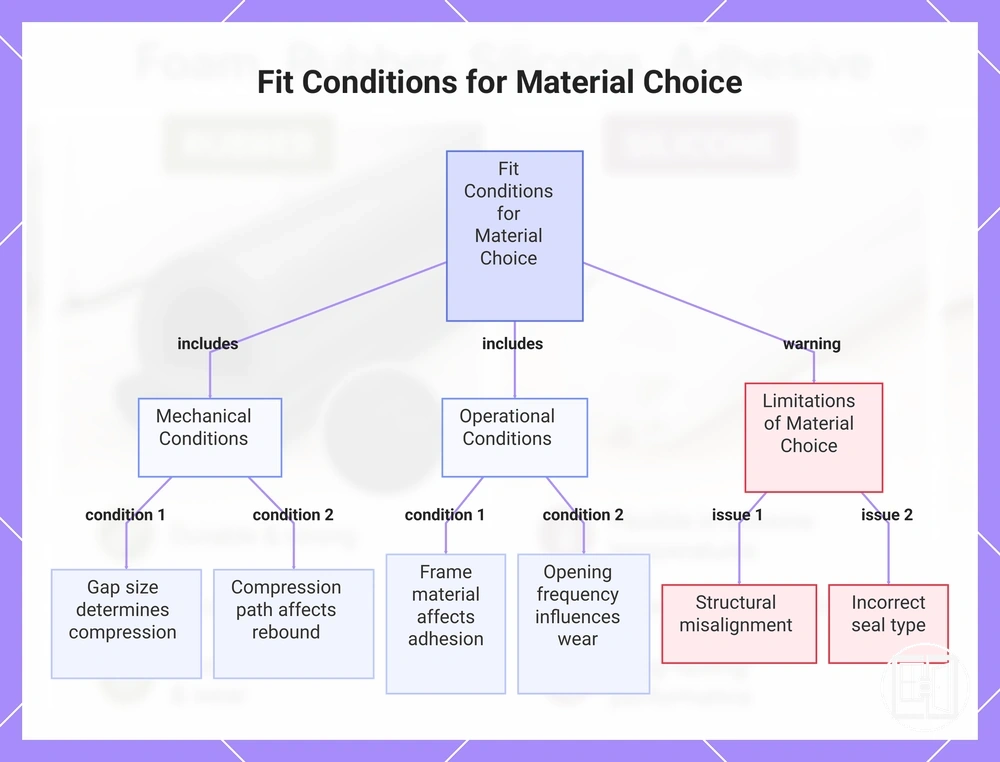
Door fit and window fit depend on gap size, frame material, opening frequency, compression path, surface condition, and exposure, and these variables directly influence material choice and compatibility. Material selection changes because weather stripping materials respond differently to each fit condition rather than following a universal compatibility rule.
Gap size determines how much compression a material must handle, while frame material affects contact behavior and adhesion stability. Opening frequency influences wear patterns through repeated movement cycles, and compression path affects how evenly a seal deforms and rebounds. Surface condition and exposure further modify compatibility by changing bonding reliability and long-term material response.
Some fit issues cannot be resolved through material choice alone when the underlying problem involves structural misalignment or incorrect seal type selection. In those cases, adjusting the sealing approach may be required rather than relying only on material variation. This remains conditional depending on installation context.
Compatibility checklist:
- Gap size matches seal thickness and compression range
- Frame material supports stable adhesion or contact sealing
- Opening frequency aligns with expected wear resistance
- Compression path allows even rebound without distortion
- Surface condition is clean and suitable for bonding or contact
- Exposure level matches material tolerance for moisture and temperature
This chart shows the key fit conditions that influence weather stripping material selection and the limitations when material choice alone cannot resolve the issue.
Best weather stripping material by use case
The best weather stripping material depends on use case, gap behavior, use frequency, exposure, and expected lifespan, because different conditions change how materials perform in real door fit and window fit scenarios. There is no universal ranking that applies across all situations.
Use case defines how a material interacts with compression and rebound over time. Gap behavior determines how consistently a seal must adapt to openings. Use frequency affects wear and deformation cycles, while exposure and expected lifespan influence material stability under moisture and temperature variation.
| Use case | Material attribute | Condition | Recommended direction |
|---|---|---|---|
| Light interior gaps | High compressibility | Low exposure, low movement | Foam or felt type behavior |
| Daily door and window use | Balanced flexibility and rebound | Moderate use frequency | Rubber or vinyl type behavior |
| Exterior exposed sealing | Moisture and temperature resistance | High exposure conditions | Silicone or EPDM type behavior |
| Rigid frame alignment systems | Structural stability | Stable compression path | Metal-backed sealing systems |
Material direction changes depending on how gap behavior, exposure, and use frequency interact in each scenario. Selection decisions should follow condition-based logic rather than fixed material ranking.
Product examples are introduced only after selection logic is established.
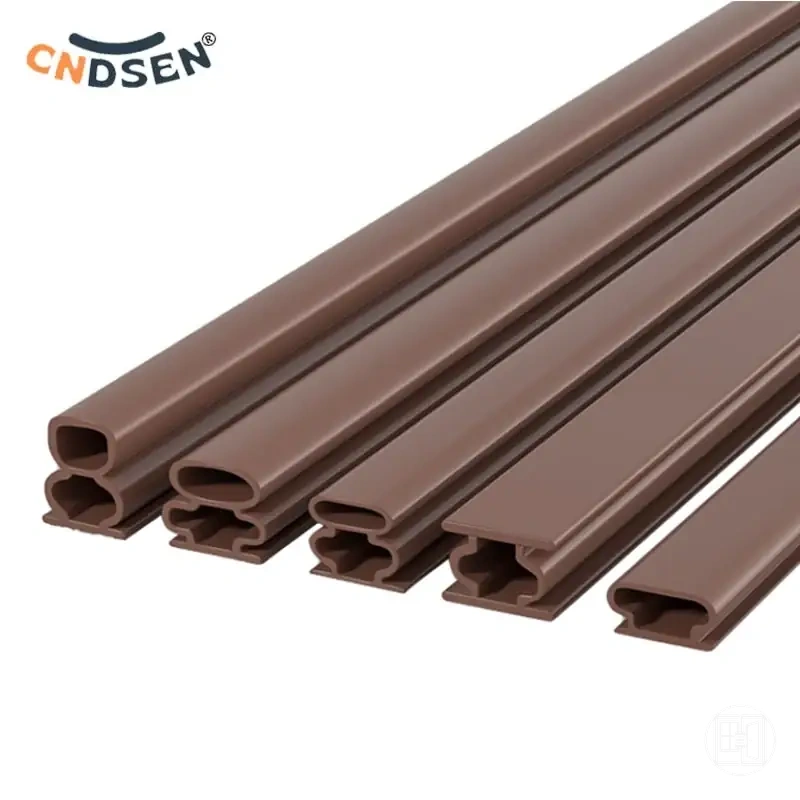
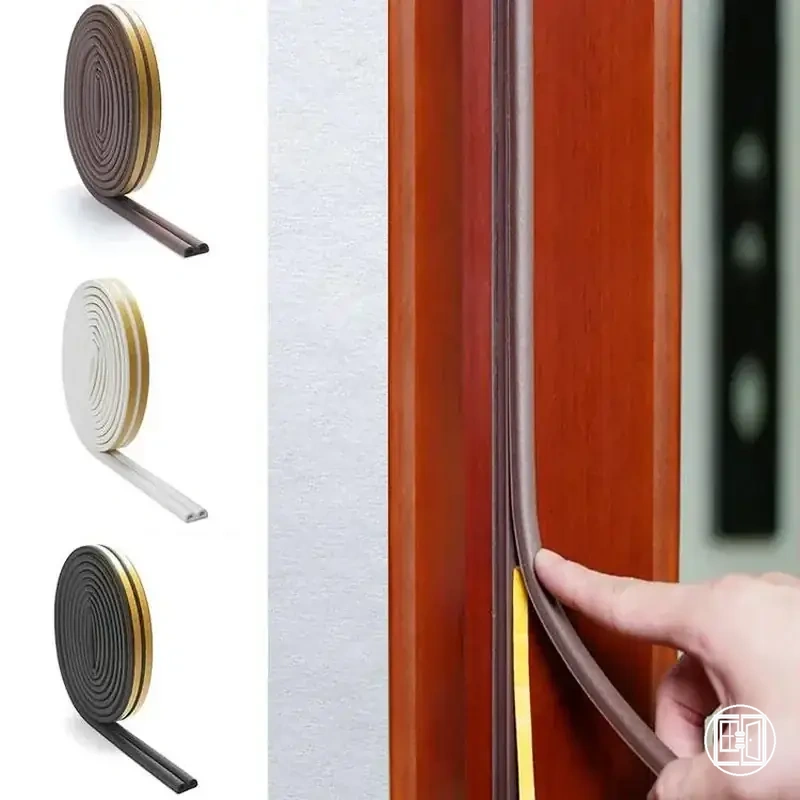
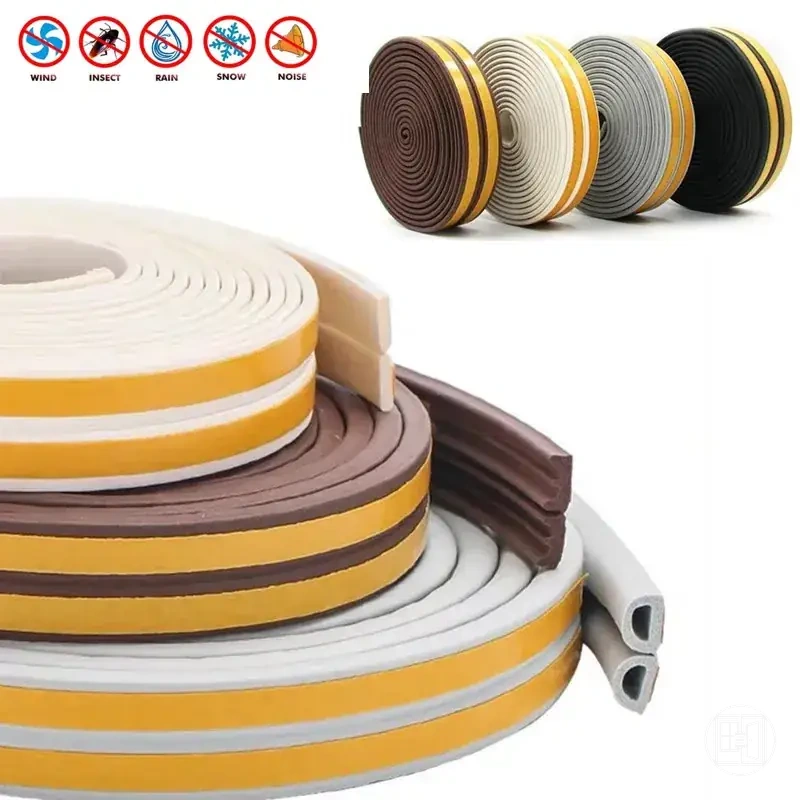
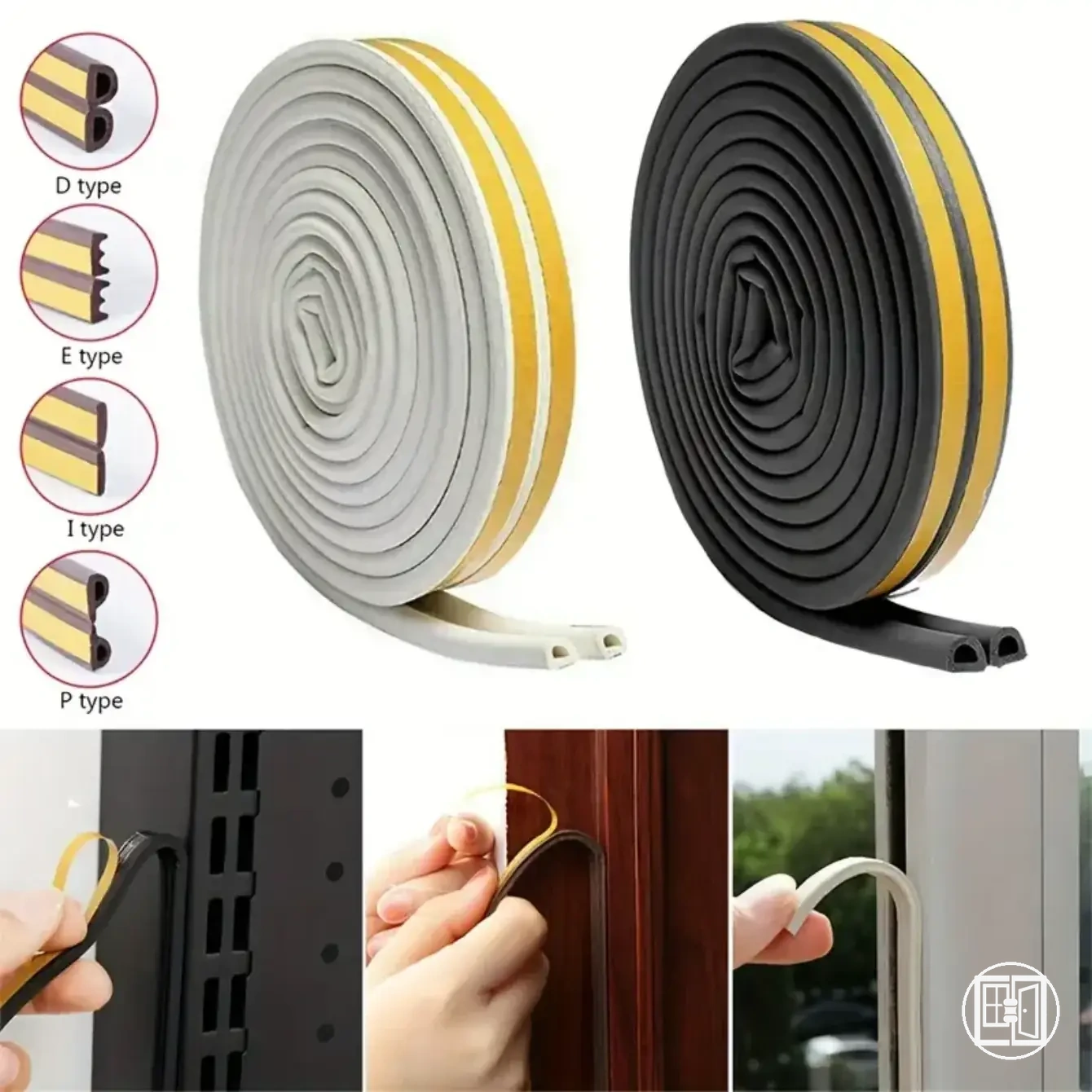
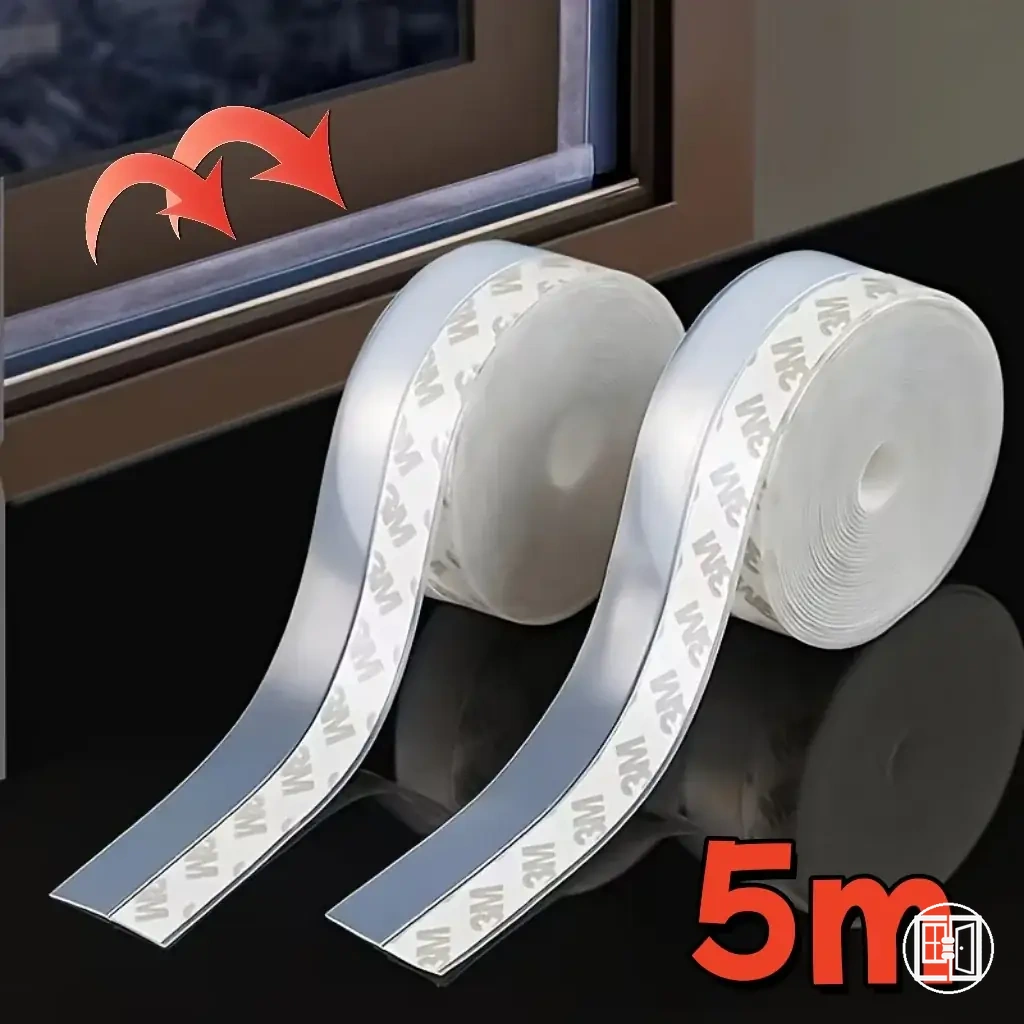
Here are product examples that may make comparison easier. Before buying, always review the compatibility criteria, essential features, and product details.
High-use exterior doors and long-term seal movement
High-use exterior doors depend on weather stripping materials that can tolerate repeated opening, closing, compression, and exposure over long-term seal movement. These conditions increase stress on the seal, so material choice must align with movement intensity and environmental exposure rather than static fit assumptions.
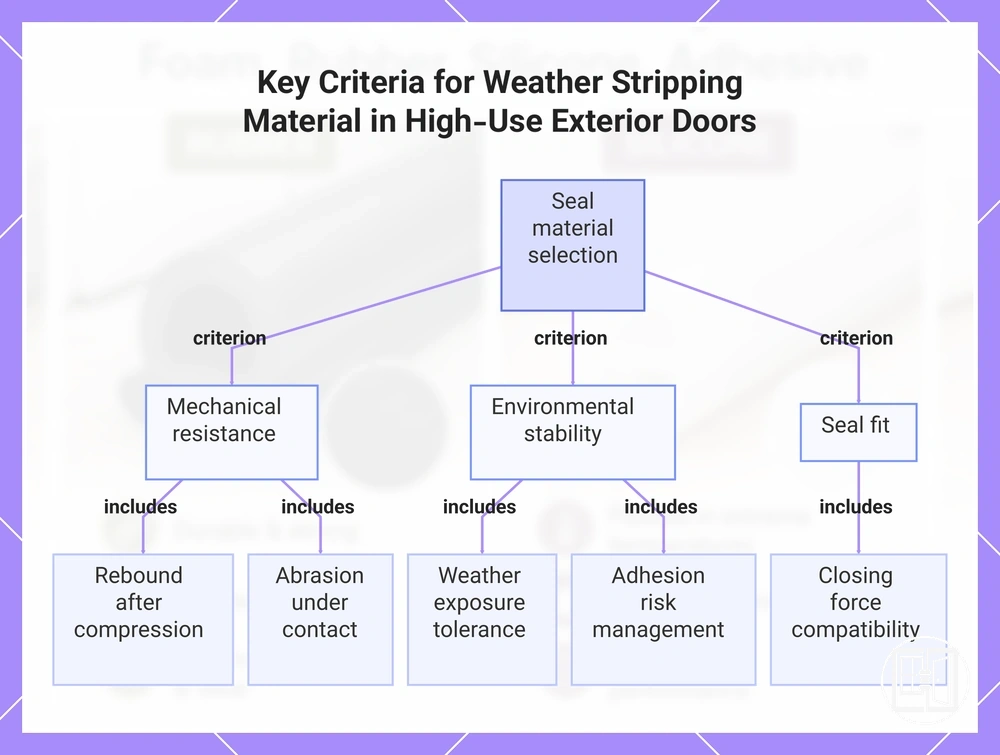
Rebound affects how well the seal returns after repeated compression cycles, while abrasion resistance influences durability under constant contact pressure. Weather exposure can gradually affect material stability, and adhesion risk may increase when surface conditions shift with moisture or temperature changes. Closing force also plays a role, since overly thick or overly soft profiles may reduce sealing efficiency in real door gap conditions.
- Rebound capacity for repeated opening and closing cycles
- Abrasion resistance under frequent contact pressure
- Weather exposure tolerance across moisture and temperature changes
- Adhesion risk based on surface condition stability
- Closing force compatibility with profile thickness and door gap
This chart shows the main criteria that influence weather stripping material selection for high-use exterior doors, including mechanical resistance, environmental stability, and seal fit considerations.
Operable windows and light draft sealing
Operable windows depend on low-profile material choices that support window movement while reducing light draft sealing issues. The right selection depends on gap size, surface contact, and maintaining consistent operation without restricting opening or closing.
Light compression, low-profile fit, and stable adhesive hold are key factors in operable window performance. Window movement and seasonal movement can shift alignment, so material choice must remain flexible enough to maintain sealing without increasing friction. In some cases, overly thick materials can interfere with normal operation and make the window harder to open or close.
- Match light compression to small gap size without overfilling the seal space
- Ensure low-profile fit does not interfere with window movement
- Check adhesive hold compatibility with frame surface contact conditions
- Account for seasonal movement that may change sealing alignment
- Avoid overly thick strips that can restrict opening or closing action
When seal type matters more than material
Seal type matters more than material when profile shape, compression path, or contact angle does not match the requirements of the installation surface or weather stripping application. In these situations, the base material cannot compensate for an incompatible seal format, so geometry becomes the primary decision factor.
Profile shape, gap size, contact angle, and installation surface determine how a seal interacts with movement and contact conditions. A material may still appear suitable, but performance changes when compression path or fit geometry does not align with the door or window setup. This separates seal type decisions from material-level selection within weather stripping systems.
When uncertainty remains, reviewing broader configuration context such as types of seals can help clarify whether the limitation comes from material choice or seal format mismatch.
Here are product examples that may make comparison easier. Before buying, always review the compatibility criteria, essential features, and product details.
| Decision focus | When it applies | Main constraint | Outcome |
|---|---|---|---|
| Material selection is sufficient | Seal type already matches application | Durability, flexibility, exposure response | Fine-tuning performance within correct format |
| Seal type takes priority | Mismatch in fit geometry or contact behavior | Profile shape, compression path, contact angle | Format correction required before material choice matters |
When seal type and material are aligned, selection becomes refinement rather than correction.